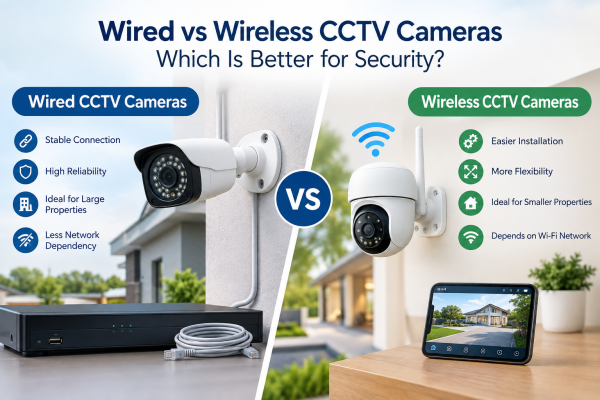
Choosing the right CCTV camera can be confusing, especially when you have to decide between wired and wireless cameras. Both options can provide reliable video surveillance, but they differ in installation, connectivity, maintenance, flexibility, and overall performance.
Understanding these differences can help homeowners and businesses pick a CCTV system. It should match their security needs and property layout.
What Are Wired CCTV Cameras?
Wired CCTV cameras use physical cables to connect the cameras to a recording device, network, and/or power source. Depending on the system, they may use coaxial cables or network cables such as Ethernet.
Because the cameras are physically connected, wired CCTV systems generally provide a stable connection and are suitable for permanent security installations.
Wired cameras are commonly used in:
-
Homes and residential societies
-
Offices
-
Retail stores
-
Warehouses
-
Schools
-
Factories
-
Commercial buildings
What Are Wireless CCTV Cameras?
Wireless CCTV cameras use a wireless network, typically Wi-Fi, to transmit video data. Many wireless cameras still need power unless they run on batteries.
So, "wireless" does not always mean no cables.
These cameras are often easier to install and can be a convenient option where running network cables is difficult.
Wireless CCTV cameras can be useful for:
-
Apartments and homes
-
Small offices
-
Temporary monitoring locations
-
Areas where cable installation is difficult
-
Locations where flexible camera placement is important
Key Differences Between Wired and Wireless Cameras
1. Installation
Wired CCTV systems usually require cable installation between cameras and the recording or networking equipment. This can take more planning, particularly in large buildings.
Wireless cameras generally require less cabling for data transmission, making installation more flexible. However, they still need a reliable power source unless they use batteries or another alternative power arrangement.
2. Connection Reliability
One of the biggest differences is connectivity.
Wired cameras use physical connections. This can provide stable video when cables and network equipment are installed correctly.
Wireless cameras depend on Wi-Fi signal strength and network performance. Walls, distance, interference, and network congestion can sometimes affect connectivity.
3. Video Quality
Both wired and wireless cameras are available in high-resolution options, including Full HD, 4MP, 5MP, and higher resolutions.
Video quality depends more on the camera’s sensor, lens, resolution, lighting, compression, and other specs. It depends less on whether the camera is wired or wireless.
4. Flexibility
Wireless cameras generally offer greater flexibility when changing camera locations. They can be easier to reposition without installing new data cables.
Wired cameras are less flexible after installation because relocating them may require additional cabling.
5. Power Requirements
Wired systems can use different power options, like separate power cables or Power over Ethernet (PoE). This works for compatible network cameras.
Wireless cameras still commonly need electrical power. Some models use batteries, but battery-powered cameras require periodic charging or battery replacement.
6. Maintenance
Wired CCTV systems can require inspection of cables, connectors, power supplies, switches, and recording equipment.
Wireless systems require attention to Wi-Fi connectivity, signal strength, power, firmware, and network performance.
Neither system is completely maintenance-free.
7. Scalability
Wireless cameras can be convenient when adding cameras to an existing network, particularly in smaller installations.
However, adding many wireless cameras can increase the load on the Wi-Fi network. Larger properties may benefit from a properly planned wired network infrastructure.
Wired vs Wireless CCTV Cameras: Quick Comparison
|
Feature |
Wired CCTV Cameras |
Wireless CCTV Cameras |
|
Installation |
Requires cabling |
Less data cabling |
|
Connectivity |
Generally stable |
Depends on Wi-Fi/network |
|
Flexibility |
Lower after installation |
Higher |
|
Power |
Cable or PoE options |
Usually requires power |
|
Network dependency |
Lower for some systems |
Higher |
|
Large installations |
Often suitable |
Requires careful Wi-Fi planning |
|
Relocation |
More difficult |
Generally easier |
|
Maintenance |
Cable and equipment checks |
Network and power checks |
Which CCTV Camera Is Better for Your Property?
There is no single answer for every property.
Choose wired CCTV cameras if:
-
You need a permanent surveillance system.
-
You want a stable network connection.
-
You are securing a large property.
-
You are installing cameras during construction or renovation.
-
You need multiple cameras and centralized recording.
Choose wireless CCTV cameras if:
-
You want easier installation.
-
Running cables is difficult.
-
You need greater flexibility in camera placement.
-
You are monitoring a smaller property.
-
You have a reliable Wi-Fi network.
Can You Use Both Wired and Wireless Cameras?
Yes. A security system can sometimes combine wired and wireless cameras, depending on the camera models, recorder, network configuration, and compatibility.
A hybrid approach is useful when some areas are easy to cable, but others are hard to reach.
Final Thoughts
The choice between wired and wireless CCTV cameras depends on your property size and layout. It also depends on your network setup, installation needs, budget, and long-term security goals.
Wired cameras are often a strong choice for stable, permanent installations, while wireless cameras can provide greater flexibility and simpler installation in suitable environments.
Before choosing a CCTV system, consider more than just the camera type. Look at video resolution, night vision, storage, remote viewing, network reliability, weather resistance, and maintenance requirements. A properly planned system can provide more dependable security and better long-term value.