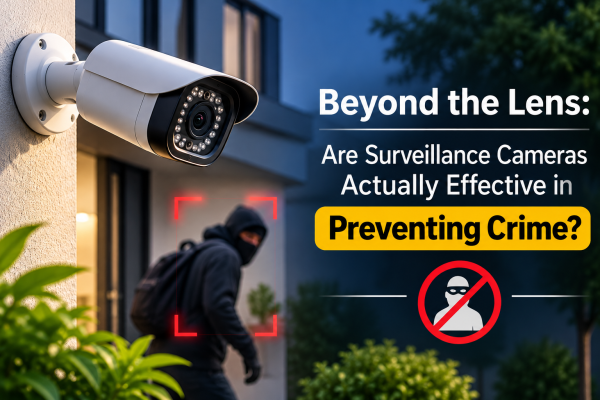
We’ve all seen the footage: a grainy, nighttime video of a porch pirate snatching a package, or a storefront break-in captured in high definition. Today, security cameras are everywhere—on our homes, outside our offices, and spanning public streets. But as these digital eyes become a standard part of our daily lives, a critical question remains: Are surveillance cameras actually effective in preventing crime, or do they just record it happening?
For decades, criminologists, law enforcement agencies, and security experts have studied this exact question. The answer is nuanced: while cameras are not an absolute shield against every type of crime, extensive research proves that they are highly effective deterrents—provided they are used correctly and as part of a layered security strategy.
Let’s break down the data, the science, and what actually works when it comes to camera-driven crime prevention.
What the Data Says: Do Cameras Actually Reduce Crime?
When looking at broad, historical data, the evidence is clear: surveillance works, but its impact varies based on location and the type of crime.
According to a massive, 40-year systematic review and meta-analysis published by the Office of Justice Programs (Piza et al., 2019), closed-circuit television (CCTV) is associated with an overall 13% reduction in crime across hundreds of evaluated areas.
However, looking at that single number doesn’t tell the whole story. When we examine where and how cameras are used, their effectiveness spikes dramatically:
-
The Parking Lot Triumph: The same 40-year study found that CCTV’s biggest and most consistent impact is in car parks and parking lots, where they were shown to reduce vehicle and property crime by up to 37%.
-
Residential Areas: Neighbourhoods and homes with visible cameras see a statistically significant decrease in property crimes like burglary and trespass. According to a study by the University of North Carolina’s Department of Criminal Justice & Criminology, which surveyed over 400 incarcerated burglars, 60% of intruders said they would seek an alternative target if they saw a camera or security system.
-
Property vs. Violent Crime: Criminologists widely agree that cameras are highly effective at preventing premeditated property crimes (like theft, burglary, and vandalism) but have little to no effect on impulsive violent crimes or crimes of passion, where the perpetrator is not acting rationally or considering the consequences.
Why Cameras Prevent Crime: The Psychology of Visibility
Surveillance cameras do not physically stop a criminal, so how do they prevent crime? The answer lies in Situational Crime Prevention and the psychology of the offender.
-
Increased "Perceived Risk": Most property criminals are opportunistic. They look for easy targets with a low risk of getting caught. A visible camera instantly raises the "perceived risk" of identification, capture, and prosecution. To a burglar, a camera means their face, clothing, and vehicle are being logged, which often prompts them to move on.
-
The "Guardianship" Effect: In criminology, the "routine activities theory" suggests that crime occurs when a motivated offender meets a suitable target in the absence of a capable guardian. Visible cameras create a sense of "digital guardianship." When people (both law-abiding citizens and would-be offenders) know they are being watched, their behavior changes.
-
The Power of Signage: Just telling people they are being watched has a massive impact. Studies show that combining cameras with "Video Surveillance in Progress" signs further boosts their deterrent effect.
The Game-Changer: Active Monitoring vs. Passive Recording
If there is one finding that completely reshapes how we view camera effectiveness, it is the difference between active and passive systems.
-
Passive (Record-Only) Systems: These are cameras that record footage to a hard drive or cloud, only to be checked after a crime has occurred. While incredibly valuable for police investigations and insurance claims, passive systems have a much lower deterrent effect.
-
Active (Monitored) Systems: Modern security features like artificial intelligence, real-time alerts, and live guard monitoring make a massive difference. When a camera is actively monitored—either by a professional monitoring service or via real-time smartphone alerts—the camera becomes a proactive tool. If an intruder is spotted on a perimeter, a siren can be sounded, an audio warning can be broadcast ("You are trespassing, the police have been called"), or authorities can be dispatched immediately.
Research shows that active systems combined with other interventions (such as motion lighting and security personnel) generate a 34% reduction in crime, compared to almost no statistical impact for stand-alone, poorly placed passive cameras.
Why Camera Placement and Quality Matter
Just putting a camera up doesn't guarantee safety. To maximize the preventative power of a surveillance system, several factors must be considered:
-
Visibility is Key: If you want to deter crime, do not hide your cameras. While covert cameras have their place in internal investigations, visible cameras are what make a burglar change their mind.
-
Quality and Lighting: Blur, glare, and poor nighttime visibility render cameras useless for identification. To truly prevent crime, cameras need to be high-definition, feature infrared or color night vision, and be backed by motion-activated lighting to illuminate the area when someone approaches.
-
Smart Analytics: Modern AI can distinguish between a stray animal and a human intruder. This prevents "alert fatigue" (where you ignore notifications because of false alarms) and ensures you are only notified when an actual threat is present.
The Bottom Line: Part of a Layered Defense
Are surveillance cameras effective in preventing crime? Yes, but they are not a silver bullet.
If you view a camera as a standalone "force field" that will make your property invincible, you will be disappointed. However, if you treat cameras as the "eyes" of a layered security strategy—combining them with good lighting, strong physical locks, visible security signage, and real-time monitoring—they are incredibly effective.
By increasing the risk of detection and providing an digital "capable guardian," surveillance cameras successfully push opportunistic criminals away, protect your assets, and provide the ultimate security benefit: peace of mind.