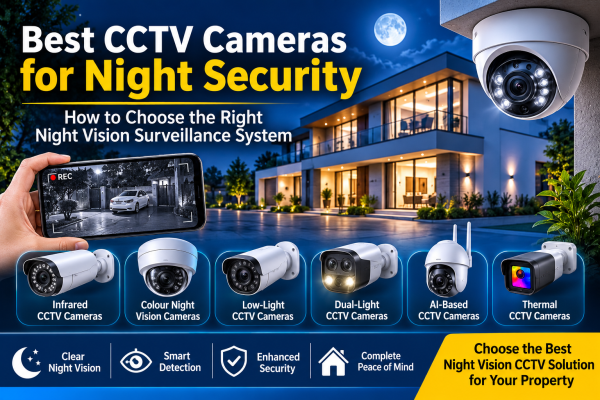
Security threats do not stop when the sun goes down. Residential properties, commercial buildings, shops, parking areas, and warehouses are more at risk at night. Visibility is lower at night. This makes a reliable CCTV surveillance system an important part of modern security planning.
However, choosing a CCTV camera for night-time monitoring requires more than simply checking its resolution or price. The camera must capture clear images in low light, detect movement accurately, and record useful footage all night.
Modern CCTV technology offers many options. These include infrared night vision and colour night vision. It also includes low-light cameras and smart motion detection. Advanced AI surveillance systems are also available.
In this guide, we explain how different CCTV technologies work at night. We also explain how to choose the best surveillance system for your property.
Why Is Night Vision Important in CCTV Surveillance?
Traditional CCTV cameras may capture excellent footage during daylight but struggle when the surrounding light becomes insufficient. Without suitable night vision technology, recordings can become dark, unclear, or difficult to identify.
Night vision technology helps overcome these limitations by improving visibility in low-light environments.
Here are some important reasons to choose CCTV cameras with night vision:
-
Monitor entrances and exits after dark.
-
Identify suspicious activities around your property.
-
Improve security in parking spaces and outdoor areas.
-
Record activities in poorly illuminated locations.
-
Monitor shops, offices, and warehouses after closing hours.
-
Maintain surveillance even when there is no visible lighting.
A suitable night vision system can provide continuous security monitoring and help preserve important evidence when incidents occur.
1. Infrared CCTV Cameras for Complete Darkness
Infrared CCTV cameras are a popular choice for night-time surveillance. They use infrared LEDs to light up the area being monitored.
This light is invisible or almost invisible to the human eye.
When the surrounding light becomes insufficient, the camera automatically switches to infrared night mode.
These cameras usually capture black-and-white footage in complete darkness.
Advantages:
-
Effective monitoring in dark environments.
-
Automatic day-to-night switching.
-
Suitable for indoor and outdoor applications.
-
Reliable performance for general surveillance.
-
Available in different resolutions and night vision ranges.
Ideal Applications: Home entrances, staircases, shops, office corridors, parking areas, and warehouses.
2. Colour Night Vision Cameras for Better Identification
Colour Night Vision cameras are useful when identifying visual details is important. They are designed to capture colour images in low light using sensitive image sensors. Depending on the model, they include built-in white-light illumination.
Unlike traditional infrared cameras, these systems can provide colour recordings at night when sufficient light is available.
Colour footage can help distinguish clothing, vehicle colours, and other important details.
Advantages:
-
Better colour identification during nighttime.
-
Improved visual information for security monitoring.
-
Useful for monitoring gates and entrances.
-
Available with different illumination and smart-lighting options.
Ideal Applications: Residential buildings, retail shops, office entrances, parking lots, and commercial properties.
3. Low-Light CCTV Cameras for Outdoor Surveillance
Low-light CCTV cameras are designed to capture usable footage in environments where natural or artificial lighting is limited.
They use advanced image sensors and image-processing technologies to improve brightness and visibility without always requiring powerful infrared illumination.
Some advanced low-light models can maintain colour images even after sunset, depending on the available ambient light.
Advantages:
-
Improved image visibility in dim environments.
-
Better performance in areas with street lighting.
-
Reduced dependence on additional illumination in suitable conditions.
-
Useful for monitoring outdoor surroundings.
Ideal Applications: Residential societies, building boundaries, roads, parking areas, and commercial outdoor spaces.
4. Smart Dual-Light CCTV Cameras
Dual-light CCTV cameras combine infrared LEDs and white-light LEDs in a single surveillance camera.
Under normal nighttime conditions, the camera may use infrared illumination. When supported motion detection identifies a person or vehicle, the white light can activate to provide colour footage.
Some models also allow users to customise their lighting modes.
Advantages:
-
Combines infrared and colour night surveillance.
-
Can automatically activate white light when motion is detected.
-
Helps capture additional visual details.
-
Provides flexible night monitoring options.
Ideal Applications: Home gates, front yards, shops, parking areas, and building entrances.
5. AI-Based CCTV Cameras for Intelligent Night Monitoring
AI-powered CCTV cameras add intelligent detection features to conventional video surveillance.
Depending on the model, these cameras can identify human movement, vehicles, and activity in specified areas. Some systems also provide intrusion alerts and line-crossing detection.
When combined with good night vision technology, AI-enabled cameras can make nighttime monitoring more efficient.
Advantages:
-
Human and vehicle detection on supported models.
-
Intelligent motion alerts.
-
Reduced unnecessary notifications.
-
Monitoring of restricted areas.
-
Integration with compatible mobile applications and recording systems.
Ideal Applications: Offices, warehouses, residential societies, commercial buildings, and large properties.
6. Thermal CCTV Cameras for Specialised Security
Thermal cameras detect heat emitted by people, animals, and objects instead of relying on visible light.
This technology makes them useful for detecting movement in complete darkness and certain challenging visibility conditions.
However, thermal imaging does not show the same facial details as standard CCTV cameras.
It also does not show clothing colours.
It does not show other usual visuals either.
Advantages:
-
Detects heat signatures in complete darkness.
-
Does not require visible illumination.
-
Useful for monitoring large outdoor areas.
-
Suitable for specialised perimeter security.
Ideal Applications: Industrial facilities, restricted premises, large warehouses, and high-security locations.
Factors That Determine Night-Time CCTV Image Quality
Even if two CCTV cameras have the same resolution, their night-time performance may be different. Several technical factors influence the quality of recorded footage.
1. Image Sensor
The image sensor plays an important role in capturing light. Cameras with better low-light sensitivity can produce clearer images in dark environments.
2. Infrared Range
For IR cameras, check the specified infrared illumination range. The required range depends on the distance between the camera and the area being monitored.
3. Lens Quality
A suitable lens helps the camera capture the required field of view. Lens selection should consider the monitoring distance and the level of detail needed.
4. Camera Resolution
CCTV cameras are available in 2MP, 4MP, 5MP, and higher resolutions. Higher resolution can provide more detail, but it does not automatically guarantee better night vision.
5. WDR Technology
Wide Dynamic Range helps balance bright and dark areas in scenes with mixed lighting.
It works well at entrances and near bright lights.
6. Weather Protection
Outdoor CCTV cameras should have suitable weather protection. Depending on the installation location, IP66 or IP67-rated models may be appropriate.
7. Recording and Storage
A good surveillance camera also needs a compatible DVR or NVR and sufficient storage capacity. Check recording quality, frame rate, and retention requirements before choosing the system.
Best CCTV Camera for Different Night-Time Security Requirements
The right camera depends on the property and the type of monitoring required.
|
Property Type |
Recommended CCTV Technology |
|
Independent House |
IR or Colour Night Vision |
|
Residential Society |
Starlight or AI Night Vision |
|
Retail Shop |
Colour Night Vision |
|
Office Building |
IR or AI-Based CCTV |
|
Parking Area |
Dual-Light or Colour Night Vision |
|
Warehouse |
IR or Low-Light CCTV |
|
Industrial Facility |
Thermal and AI-Based Surveillance |
For most residential and commercial applications, infrared and colour night vision cameras are practical options. More advanced technologies can be considered when the property requires specialised monitoring.
Common Mistakes to Avoid When Installing Night Vision CCTV Cameras
Buying a high-quality CCTV camera is only one part of an effective security system. Incorrect installation can reduce its performance significantly.
Avoid these common mistakes:
-
Installing Cameras Too High or Too Low: A wrong mounting height can make it hard to capture clear details of people and vehicles.
2. Ignoring Lighting Conditions: Strong lights, shadows, and reflective surfaces can affect image quality.
3. Choosing the Wrong Night Vision Range: A camera may not provide sufficient illumination for the required monitoring distance.
4. Overlooking Blind Spots: Make sure entrances, gates, and important areas are properly covered.
5. Ignoring Regular Maintenance: Dust, insects, and cobwebs can affect night-time image clarity, especially around infrared LEDs.
6. Not Checking Night Recordings: Always test the camera after sunset to confirm that it captures clear and useful footage.
Wired or Wireless CCTV: Which Is Better for Night Surveillance?
Both wired and wireless CCTV systems can support night vision. Their night-time image quality mainly depends on the camera’s sensor, lens, lighting, and recording features. It does not depend on whether the connection is wired or wireless.
Wired CCTV Systems:
-
Provide a stable connection through suitable cabling.
-
Are commonly used for multi-camera installations.
-
Can support continuous recording through compatible DVR or NVR systems.
Wireless CCTV Systems:
-
Offer flexible installation options.
-
Reduce the need for video signal cabling.
-
Depend on suitable wireless connectivity for reliable communication.
-
May require additional planning for power supply and network coverage.
For larger properties and installations requiring multiple cameras, wired CCTV systems are often a practical choice. Wireless systems can be suitable where cabling is difficult or flexibility is important.
Conclusion
Selecting the best CCTV camera for night security depends on your property's requirements, lighting conditions, surveillance distance, and budget. Infrared cameras work well in complete darkness. Colour night vision cameras capture key visual details. Dual-light systems combine different lighting technologies.
For properties requiring advanced monitoring, AI-powered and thermal cameras offer additional security capabilities.
Before purchasing a CCTV system, compare its night vision performance, image sensor, resolution, illumination range, recording compatibility, and installation requirements. A properly planned surveillance system can improve nighttime visibility and help protect your property around the clock.