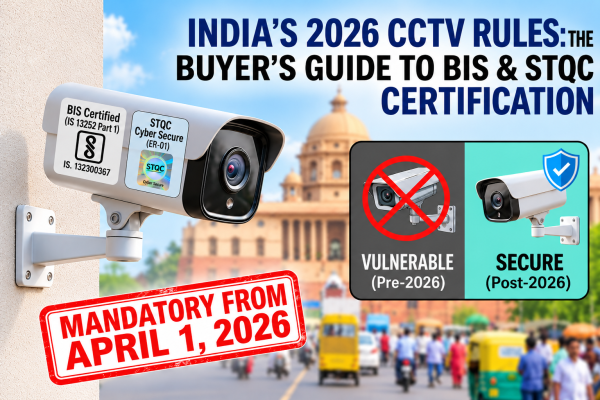
Starting April 1, 2026, the landscape of electronic surveillance in India changed dramatically. If you are planning to buy, sell, or install a CCTV camera for your home, business, or industrial complex, old purchasing habits no longer apply.
The Ministry of Electronics and Information Technology (MeitY) has officially enforced strict cybersecurity standards. Under these new rules, importing or manufacturing non-compliant surveillance gear is illegal. For buyers, this means you must now verify two critical certifications before swiping your card: BIS and STQC.
Here is everything you need to know to navigate the 2026 CCTV rules and ensure your security system isn't actually a vulnerability.
Why Did the Rules Change? The Shift to Secure IoT
Historically, connected CCTV cameras were notoriously insecure. Many IP cameras shipped with weak default passwords (like "admin/12345") and unencrypted video feeds. This made them easy targets for hackers, who could hijack the devices to create botnets (DDoS attacks) or spy on private spaces.
To combat this at the manufacturing level, the government introduced the "Essential Requirements (ER)" for Security of CCTV. After several extensions to allow the industry to adapt, full compliance became mandatory on April 1, 2026.
Think of these new rules not as red tape, but as a "cybersecurity vaccine" for your surveillance network.
The Compliance Tag Team: BIS vs. STQC Explained
Buyers often use these acronyms interchangeably, but they represent two distinct stages of product approval.
|
Certification Body |
Role in CCTV Compliance |
What It Verifies |
|
STQC (Standardisation Testing and Quality Certification) |
The Tester. A MeitY directorate that operates accredited labs. |
They perform deep technical testing on the camera's firmware, hardware, and network protocols against the "Essential Requirements" to prove it is secure from cyberattacks. |
|
BIS (Bureau of Indian Standards) |
The Regulator. India's national standards body. |
They grant the final legal license to sell the product in India. BIS issues a unique R-Number (found on the camera or box) only after receiving a successful STQC test report. |
In plain English: STQC says, "This camera is secure." BIS says, "Because it is secure, you are legally permitted to sell it in India."
What Makes a Camera Compliant? The "Cyber-Hardening" Checklist
When a camera passes STQC testing and receives BIS certification, it means it has been hardened against modern threats. A compliant camera must feature:
-
No Default Passwords: The device must force you to set a strong, unique password during the initial setup.
-
Secure Boot: Ensures only authentic, manufacturer-approved software can run on the device, preventing hackers from installing malicious firmware.
-
Encrypted Communication: Video streams and data sent to your phone or NVR must be encrypted (using protocols like TLS/HTTPS) so they cannot be intercepted on the local network.
-
Closed Ports: Unnecessary network ports used for debugging must be disabled, removing common entry points for attackers.
-
Hardware Tamper Protection: Physical safeguards to prevent unauthorized firmware rollback (downgrading to an older, vulnerable version).
Buyer Beware: 4 Steps to Verify Legitimacy Before You Buy
Because certification is tied to the exact model number and chipset, you cannot assume every camera from a well-known brand is compliant. Rogue importers still try to sell old, uncertified stock.
Before you finalize a purchase for your home or office security project, use this checklist:
-
Demand the Model Number: Get the exact alpha-numeric model code from the vendor's quotation.
-
Cross-Reference the BIS R-Number: Ask the seller for the camera's BIS registration number. Verify this number on the official BIS CRS portal (crsbis.in) to ensure the exact model is registered and active.
-
Inspect the Physical Label: Legally compliant cameras sold after April 1, 2026, must bear the standard BIS ISI mark along with the required security declaration text on the packaging or product casing.
-
Include a Compliance Clause in POs: For B2B or corporate procurement, always add a clause to your Purchase Orders stating payment is conditional upon delivery of BIS/STQC certified gear, with full liability on the supplier for non-compliance.
By insisting on BIS and STQC certification, you are not just following the law—you are building a surveillance system that actually protects your privacy and data.