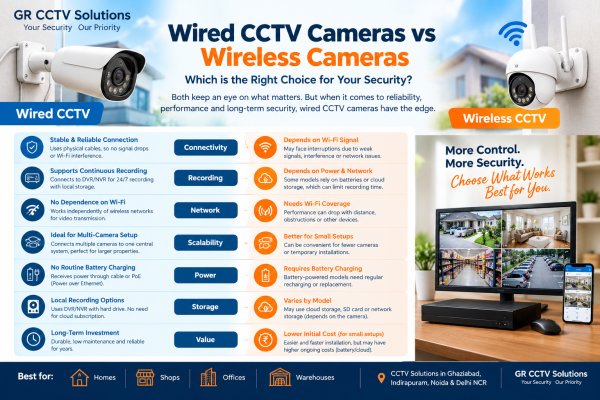
When you choose a CCTV camera system for your home or business, you need to make one key decision.
You must choose between wired cameras and wireless cameras. Both technologies help monitor your property, but their connectivity, power requirements, installation methods, and recording capabilities can differ significantly.
Wireless cameras are popular because they can be easier to install and relocate. However, wired CCTV cameras remain a preferred option for many homeowners, shopkeepers, offices, and commercial properties that require dependable monitoring and centralized recording.
So, what makes wired CCTV cameras a practical choice? Let's explore their key advantages, limitations, and the situations where they may be the better investment.
1. Consistent Video Transmission
A major advantage of wired CCTV cameras is their use of physical cables for video or network transmission. Depending on the system, these may be coaxial cables or Ethernet cables.
Because the main connection does not use Wi-Fi, wired cameras avoid issues from weak signals, interference, and congestion.
This is particularly beneficial in buildings with thick walls, multiple floors, or areas where wireless coverage is inconsistent.
For example, a shop owner who needs to monitor the entrance, billing counter, and stockroom can use a wired system to connect cameras to a central recorder.
2. Reliable Monitoring for Important Areas
Some areas of a property need more consistent monitoring than others. These may include entrances, cash counters, parking areas, warehouses, and access points.
A wired CCTV system makes it easy to connect multiple cameras. It also lets you manage footage using a compatible DVR or NVR.
With suitable equipment, storage, and power backup, the system can be configured for continuous recording. This makes it useful for businesses that need to review incidents or verify activities after working hours.
Remember that reliability also depends on the quality of the equipment, proper installation, and regular maintenance.
3. Less Dependence on Wireless Network Conditions
Wireless cameras generally use Wi-Fi or another wireless connection to communicate with the network or recording device. Their performance can be affected by distance, obstructions, and interference.
Wired cameras use physical connections for their primary video transmission or network communication, reducing dependence on wireless coverage.
This can be very helpful in large houses, offices, and commercial buildings where one router cannot cover every area.
However, wired cameras with remote viewing may still need internet access to show live video on your phone.
4. A Convenient Solution for Multi-Camera Installations
Installing several security cameras requires careful planning. You need to choose where to place cameras. You also need to plan cable routes. You must decide where to install the recording equipment.
Wired CCTV systems are often suitable for properties that need multiple cameras connected to one central recording setup.
Common applications include:
-
Homes requiring indoor and outdoor surveillance
-
Retail shops monitoring entrances and billing counters
-
Offices securing reception areas and corridors
-
Warehouses monitoring stock and loading zones
-
Apartment buildings covering entrances and common areas
A well-planned system makes it easier to review footage from different camera locations using compatible recording equipment.
5. No Routine Battery Charging for Standard Wired Cameras
Battery-powered wireless cameras offer flexibility, but their batteries eventually need recharging or replacement. Battery life varies according to usage, recording frequency, temperature, and camera settings.
Conventional wired CCTV cameras receive power from a suitable power supply. Supported IP cameras can get power and network access through one Ethernet cable using Power over Ethernet (PoE).
This removes the need for routine battery charging at each camera location.
For properties that need cameras running for long periods, wired power can be a practical advantage. A suitable UPS or backup power arrangement can also help keep the system operational during power interruptions.
6. Greater Flexibility in Local Recording
Many wired CCTV systems use a DVR or NVR with a hard drive to store recorded video locally.
Local recording can offer several benefits:
-
Footage can be reviewed from the recording device.
-
Storage capacity can be selected according to the number of cameras and retention requirements.
-
A cloud-storage subscription may not be necessary.
-
Multiple cameras can be managed through a compatible recording system.
Wireless cameras can also support local storage, so this advantage depends on the particular model and system configuration.
Before you buy a CCTV system, check how many days of video it can store.
Also check if the recording method meets your security needs.
7. A Practical Investment for Long-Term Use
A CCTV system should be chosen based on how it will be used over several years, not just its upfront cost.
Wired systems can be a good long-term choice. This works best when cameras stay in fixed spots. The property also needs good paths for cable runs.
Although professional cabling may increase the initial installation cost, conventional wired cameras do not require camera battery charging. Many systems also support local recording without recurring cloud fees.
On the other hand, installing cables in an existing building can be expensive or inconvenient. Wireless cameras may therefore be more economical for small installations or locations where cable routing is difficult.
The best investment is the system that balances reliability, installation costs, maintenance, and required features.
8. Improved Planning for Indoor and Outdoor Security
Wired CCTV cameras are available in different designs for different environments.
Indoor cameras: Suitable for reception areas, living rooms, corridors, shops, and offices.
Outdoor cameras: Weather-rated models can be installed near entrances, gates, parking areas, and building perimeters.
Dome cameras: Often used indoors or in covered commercial areas, depending on the model.
Bullet cameras: Commonly used for outdoor monitoring and viewing specific approaches or access points.
Camera selection should also consider resolution, night vision, viewing angle, and weather protection. Also consider the distance needed to capture important details.
9. Wired CCTV Cameras Can Help Reduce Wireless Interference Concerns
Wireless networks can experience interference from other devices and obstacles that weaken the signal. A wired camera's primary connection is not affected by Wi-Fi interference in the same way.
This can make wired systems a sensible option in environments where wireless connectivity is unreliable.
However, wired systems can still have issues from damaged cables, loose connectors, bad power supplies, or network setup errors. Professional installation and routine checks remain important.
10. Suitable for Homes, Shops, and Offices
The ideal CCTV setup depends on the property being monitored.
For homes: Wired cameras can provide consistent monitoring of entrances, staircases, parking spaces, and outdoor areas.
For retail shops: Multiple cameras can help monitor customer areas, billing counters, stockrooms, and exits.
For offices: A wired system can connect cameras across reception areas, corridors, and designated access points.
For warehouses: Wired cameras may be suitable for large spaces that require centralized recording and multiple camera views.
For businesses in Ghaziabad, Indirapuram, Noida, and Delhi NCR, choosing the right setup starts with identifying vulnerable areas and determining the required camera coverage.
Wired vs Wireless CCTV Cameras: Which Should You Choose?
|
Requirement |
Wired CCTV |
Wireless CCTV |
|
Stable primary connection |
Strong option with correctly installed cables |
Depends on wireless signal quality |
|
Permanent camera positions |
Very suitable |
Suitable, but may need good Wi-Fi coverage |
|
Quick installation |
Usually requires more work |
Often easier |
|
Battery-free operation |
Yes, for conventional powered cameras |
Depends on whether the camera uses batteries |
|
Multiple cameras |
Well suited to centralized systems |
Suitable when network capacity is adequate |
|
Cable routing |
Required for traditional wired setups |
Often reduced, though power cables may still be needed |
|
Remote mobile access |
Available with supported systems and network access |
Available with supported systems and network access |
Neither system is universally better. Your property layout, budget, power availability, and recording requirements should guide your decision.
Important Factors Before Buying a Wired CCTV System
Before selecting a wired CCTV camera system, consider the following points.
1. Resolution: Choose the appropriate image quality for the areas you need to monitor.
2. Recording equipment: Confirm compatibility between cameras and the DVR or NVR.
3. Hard-drive capacity: Calculate storage requirements according to the number of cameras, recording settings, and desired retention period.
4. Night vision: Check the camera's low-light performance and whether infrared or colour night vision is appropriate.
5. Cable quality: Use compatible cables and connectors suitable for the installation distance and environment.
6. Mobile monitoring: Confirm that the system supports secure remote viewing if you want to check footage from your phone.
7. Power backup: Consider a UPS or suitable backup arrangement for power interruptions.
8. Professional installation: Correct positioning, secure cable routing, and proper configuration can improve overall system performance.
Conclusion
Wired CCTV cameras are a strong choice for people who want a permanent security system.
They offer a stable main connection and centralized recording.
They also avoid routine battery charging with standard powered cameras.
They can be particularly suitable for homes, shops, offices, and warehouses that require multiple cameras and dependable day-to-day monitoring. Wireless cameras may be preferable when flexible placement and simpler installation are more important.
Before making a decision, compare the installation requirements, ongoing costs, recording features, and coverage needs of your property.
Looking for a suitable CCTV camera system? GR CCTV Solutions can help you explore wired CCTV cameras and recording options for homes and businesses in Ghaziabad, Indirapuram, Noida, and Delhi NCR.