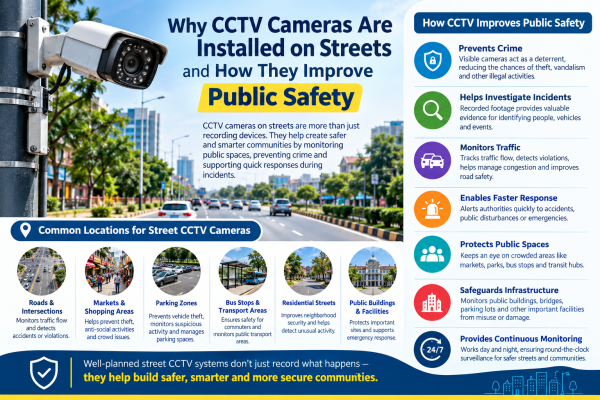
CCTV cameras have become an increasingly common part of modern streets, roads, markets, public areas, and traffic intersections. From busy city roads to residential streets, these cameras watch what is happening. They help improve public safety. They help manage traffic. They also provide video evidence after incidents.
But what exactly is the purpose behind installing CCTV cameras on streets?
Street CCTV surveillance is not simply about recording video. When planned and managed well, a CCTV network can help law enforcement and traffic control.
It can also support emergency response, crime investigation, and public safety. Government agencies and police departments in India also see CCTV as a useful tool.
It helps prevent and investigate crime.
It also supports traffic regulation and monitoring in public spaces.
Why Are CCTV Cameras Installed on Streets?
The main aim of street CCTV cameras is to improve safety. They also help authorities see public areas better. Cameras can continuously monitor selected locations and record activities that may otherwise be difficult to observe.
Here are some of the major purposes of installing CCTV cameras on streets.
1. Crime Prevention and Deterrence
One of the most important reasons for installing CCTV cameras on streets is to discourage criminal activity.
When people know an area is under surveillance, they may feel they could be identified or caught. This fear may discourage some offences. CCTV is considered a form of situational crime prevention because surveillance can increase the perceived risk of detection.
Street cameras may therefore be installed at locations such as:
-
Busy markets
-
Parking areas
-
Road intersections
-
Public transport areas
-
Crime-sensitive locations
-
Residential streets
-
Entry and exit points
-
Areas with heavy pedestrian movement
However, CCTV should be seen as one part of a wider public safety plan. It does not guarantee that crime will end.
2. Helping Police Investigate Incidents
CCTV footage can become valuable evidence after an incident has taken place.
For example, theft, assault, a road accident, vandalism, or another incident may happen on a street. Investigators may then check nearby camera footage to find out what happened.
Depending on the camera's position and image quality, footage may help investigators determine:
-
The approximate time of an incident
-
The direction in which a person travelled
-
Vehicle movement
-
The sequence of events
-
The presence of witnesses or other people
-
Possible identifying details
The Bureau of Police Research and Development says CCTV helps detect and investigate offences. It also provides video evidence to support investigations.
3. Improving Traffic Management
Street CCTV cameras are also widely used for monitoring traffic.
Cameras installed at important intersections can provide information about:
-
Traffic congestion
-
Road accidents
-
Illegal parking
-
Traffic violations
-
Vehicle movement
-
Road blockages
-
Traffic flow
India's electronic monitoring and enforcement framework uses CCTV cameras, speed cameras, and ANPR systems.
These technologies support road-safety enforcement in specified locations.
Modern traffic systems can combine camera feeds with software and control centres. This helps authorities understand traffic conditions and respond to problems.
4. Monitoring Traffic Violations
Specialized traffic cameras can help authorities identify violations such as speeding, red-light violations, or other road-rule offences.
ANPR technology can also assist with identifying vehicle registration numbers where such systems are legally deployed.
Research using traffic-camera data from Chandigarh, India, found that functioning traffic cameras were associated with an increase in observable traffic enforcement activity.
The exact capabilities depend on the camera system, software, deployment, and applicable laws.
5. Faster Response to Emergencies
Street CCTV can help authorities understand what is happening during an emergency.
For example, cameras may provide useful information during:
-
Road accidents
-
Fires
-
Public disturbances
-
Large gatherings
-
Traffic blockages
-
Suspicious activities
-
Other emergencies
Live monitoring can allow an authorised control room to identify an incident and provide relevant information to responding personnel.
Some modern surveillance systems can generate alerts from predefined events or video analytics. This reduces the need for operators to watch every camera all the time.
6. Protecting Public Places and Infrastructure
Streets contain important public infrastructure, including:
-
Traffic signals
-
Streetlights
-
Road equipment
-
Public transport facilities
-
Utility infrastructure
-
Government property
CCTV cameras can help monitor these areas and provide footage when damage, vandalism, or unauthorized activity occurs.
This can be particularly useful in locations where infrastructure is expensive or important to the functioning of a city.
7. Improving Safety in Busy Public Areas
Crowded streets can create additional safety challenges.
CCTV systems can help authorities monitor busy areas such as markets, transport hubs, public squares, and major intersections.
During large events or gatherings, cameras give a clear view of crowd movement. They help operators spot unusual situations or congestion.
This can support the work of police, emergency services, and other authorised personnel.
8. Supporting Missing-Person and Incident Investigations
CCTV footage may sometimes help authorities trace a person's movements after they were reported missing or after an incident.
For example, footage from multiple locations can potentially help establish:
Location A → Road B → Junction C → Transport Area D
The value of this footage depends on camera coverage. It also depends on image quality. It depends on how long the recordings are kept. It depends on whether the systems are properly synced. It also depends on legal access to the recordings.
9. Providing Evidence After Road Accidents
Road accidents can happen within seconds, making eyewitness accounts incomplete or conflicting.
A well-placed CCTV camera can capture important parts of an accident.
It can record how vehicles moved before the crash.
It can also record how they moved after the crash.
Footage can potentially assist authorities in determining:
-
Vehicle direction
-
Approximate timing
-
Traffic-signal conditions
-
Road activity
-
Vehicle movement
-
Events immediately before or after the accident
This can make CCTV particularly useful at major intersections and accident-prone locations.
10. Supporting Smart City and Intelligent Surveillance Systems
Modern street CCTV systems are becoming more advanced than traditional recording cameras.
Today's systems can integrate cameras with technologies such as:
-
Video analytics
-
AI-based object detection
-
Motion detection
-
ANPR
-
Centralized monitoring
-
Event-based alerts
-
Traffic analytics
-
Searchable video
Government and industry sources describe applications including public-space monitoring, traffic regulation, law-and-order management, and video analytics.
This means CCTV can increasingly function as part of a broader city-management and public-safety system.
What Types of CCTV Cameras Are Used on Streets?
Different street locations require different types of cameras.
Bullet Cameras
Bullet cameras are often used where a clearly defined viewing direction is required. Their visible design can also make the presence of surveillance obvious.
Dome Cameras
Dome cameras provide a compact design and can be suitable for various public and commercial environments.
PTZ Cameras
PTZ, or Pan-Tilt-Zoom, cameras can move horizontally and vertically and provide optical zoom. They can be useful for monitoring larger areas when an operator needs to focus on different locations.
ANPR Cameras
Automatic Number Plate Recognition cameras are designed to capture and process vehicle registration information where legally deployed.
IP Cameras
Network IP cameras send digital video to recording or monitoring systems. They can also connect to larger surveillance networks.
Where Should Street CCTV Cameras Be Installed?
The effectiveness of a street CCTV system depends heavily on proper camera placement.
Common locations include:
-
Major road intersections
-
Entry and exit roads
-
Busy markets
-
Parking areas
-
Public transport locations
-
Crime-sensitive areas
-
Important junctions
-
Areas around public infrastructure
-
Large gathering locations
Camera placement should be based on the specific security objective rather than simply installing cameras wherever possible.
Poor positioning, blocked views, inadequate lighting, or insufficient coverage can reduce the usefulness of a CCTV system.
Does CCTV on Streets Completely Stop Crime?
No. CCTV should not be considered a complete solution to crime.
Its effectiveness depends on several factors, including camera placement, image quality, lighting, monitoring, maintenance, response procedures, and how effectively footage is used.
CCTV can help deter crime, spot incidents, support investigations, and collect evidence.
It works best with other steps like good policing, street lighting, quick emergency response, and community safety programs.
Privacy and Cybersecurity Are Also Important
Installing cameras in public spaces creates responsibilities around privacy, data security, access, storage, and appropriate use of recorded footage.
The Delhi government has earlier stressed the need for clear rules for CCTV installation and use.
These rules should cover monitoring, storage, access, sharing, security, and deletion.
It also said surveillance should not be used for unjustified invasion of privacy.
Cybersecurity is another important consideration, especially for internet-connected CCTV systems. India's Ministry of Electronics and Information Technology has highlighted risks such as unauthorized access, hacking, data breaches, and vulnerabilities in surveillance systems.
Therefore, street surveillance systems should include appropriate:
-
Access controls
-
Strong passwords
-
Network security
-
Software and firmware updates
-
Secure storage
-
User authentication
-
Authorized footage access
-
Regular system maintenance
The Importance of Reliable CCTV Equipment
A street CCTV system is only useful when it can provide reliable footage when required.
Important factors to consider include:
-
Camera resolution
-
Night-vision performance
-
Low-light image quality
-
Weather resistance
-
Field of view
-
Storage capacity
-
Network reliability
-
Backup power
-
Recording reliability
-
Monitoring requirements
For outdoor applications, cameras should be selected according to the environmental conditions and the surveillance objective.
Conclusion
The purpose behind installing CCTV cameras on streets goes far beyond simply recording video.
Street CCTV systems can deter some crimes. They can support investigations. They can monitor traffic. They can record road incidents. They can improve emergency awareness. They can protect public infrastructure. They can help authorities manage busy public areas.
At the same time, effective surveillance requires careful camera placement, reliable equipment, proper maintenance, cybersecurity, controlled access to footage, and appropriate privacy safeguards.
As cities increasingly adopt intelligent traffic and surveillance technologies, CCTV cameras are becoming an important component of modern public-safety infrastructure. The goal should be to use the technology responsibly. It should provide useful security and operational benefits. It should also keep proper safeguards for the people being recorded.