When planning a CCTV system for your home, one of the first questions homeowners ask is, “How many CCTV cameras do I actually need?”
There is no fixed number that works for every property. A small apartment may need only two or three cameras, while a large independent house with multiple floors, entrances, and outdoor spaces may require eight or more.
The right number depends on your property's layout, entry points, areas that need monitoring, camera viewing angles, and the level of security you want.
Why the Number of Cameras Matters
Installing too few cameras can leave important areas uncovered. These uncovered areas are commonly known as blind spots.
On the other hand, installing too many cameras can increase equipment, storage, and maintenance costs without necessarily improving coverage.
The objective should be to install the right number of cameras in the right locations.
A properly planned CCTV system should provide useful coverage of important areas rather than simply placing a camera in every room.
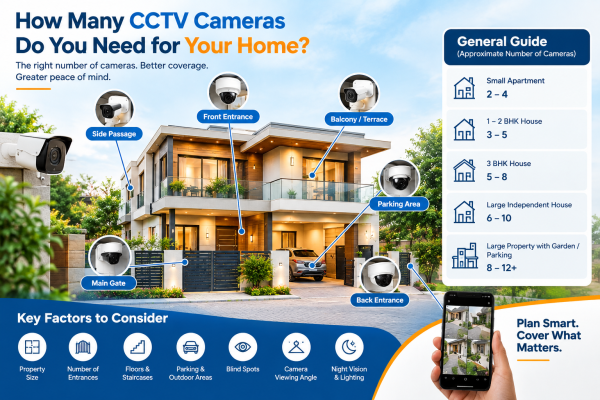
A General Guide to CCTV Cameras for Different Homes
The following is a basic starting point:
|
Property Type |
Approximate Cameras |
|
Small apartment |
2–4 |
|
1–2 BHK house |
3–5 |
|
3 BHK independent house |
5–8 |
|
Large independent house |
6–10 |
|
Large property with garden/parking |
8–12+ |
These numbers are estimates. The actual requirement should be decided after looking at the property's design and security requirements.
Start With the Entry Points
When planning a home CCTV system, begin with the places through which people can enter or leave the property.
Important points may include:
-
Main gate
-
Front door
-
Rear door
-
Side entrance
-
Garage
-
Basement entrance
-
Terrace or staircase access
If a property has several entrances, each one should either have direct camera coverage or be visible from another appropriately positioned camera.
How Many Cameras Does a 2 BHK House Need?
A typical 2 BHK house may require around 3 to 5 cameras, depending on its layout.
For example:
-
1 camera for the main gate
-
1 camera for the main entrance
-
1 camera for the parking or driveway
-
1 camera for a rear or side entrance
-
1 indoor camera for a common area, if required
A smaller property with fewer access points may need fewer cameras.
How Many Cameras Does a 3 BHK House Need?
A 3 BHK independent house may require approximately 5 to 8 cameras.
A possible arrangement could include:
-
Front gate
-
Main entrance
-
Parking area
-
Rear entrance
-
Side passage
-
Staircase
-
Important common area
-
Garden or additional outdoor area
The exact number depends on whether one camera can effectively cover multiple nearby areas.
What About a Two- or Three-Storey House?
Multi-storey properties usually require additional planning.
Instead of automatically installing a camera on every floor, identify the areas where movement between floors occurs.
For example, cameras may be useful around:
-
Main staircase
-
Landing areas
-
Balcony access
-
Floor entrances
-
Terrace staircase
-
External staircases
A camera positioned correctly can sometimes monitor a larger area and reduce the need for additional cameras.
Outdoor Cameras Are Often More Important
For many residential CCTV systems, outdoor areas deserve particular attention.
The most important outdoor locations may include:
Main Gate
The gate is a major access point and can help monitor visitors and vehicles.
Driveway
A driveway camera can monitor vehicles entering or leaving the property.
Parking
If vehicles are parked outside, dedicated coverage can help monitor the area.
Side Passage
Narrow passages around the property can otherwise become blind spots.
Backyard
If the property has a backyard or rear entrance, consider whether it needs independent coverage.
Do You Need CCTV Cameras Inside the House?
Not necessarily.
Indoor cameras can be useful in selected common areas, but installing cameras throughout the house is generally unnecessary.
Instead, homeowners can focus on security-sensitive common areas such as:
-
Main hallway
-
Living room
-
Staircase
-
Indoor entrance
-
Areas connecting important access points
Privacy should always be considered when deciding where indoor cameras are installed. Bedrooms and other highly private areas should generally not be monitored.
Camera Placement Is More Important Than Camera Count
A common mistake is to focus on the number of cameras instead of their placement.
For example, two cameras pointing toward almost the same area may provide less useful coverage than two cameras positioned at different strategic locations.
Before installation, check:
-
What each camera can see
-
Whether another camera covers the same area
-
Whether walls or trees block the view
-
Whether the camera can see clearly at night
-
Whether important entry points are covered
-
Whether there are gaps between viewing areas
The objective is to achieve maximum useful coverage with an appropriate number of cameras.
Think About Night-Time Coverage
A CCTV camera may provide excellent daytime footage but poor images after dark.
When deciding camera locations, consider how the area looks at night.
Outdoor cameras may need suitable infrared night vision or other low-light capabilities. Areas with headlights, bright lights, or strong contrast may also benefit from cameras with good WDR performance.
Therefore, camera selection should be based on both daytime and nighttime conditions.
Wide-Angle Cameras Can Reduce the Number of Cameras
A camera with a wider viewing angle can cover more of an area.
For example, one appropriately positioned camera may cover a front entrance and part of a nearby driveway.
However, wider coverage does not always mean better identification. Objects that are far away may appear smaller.
This is why the camera's resolution, lens, mounting position, and distance from the subject should all be considered together.
Don't Forget the CCTV Recorder and Storage
Adding more cameras also affects the recording system.
If you install eight cameras instead of four, your storage requirements can increase significantly, particularly when all cameras record continuously.
Before selecting an NVR or DVR, consider:
-
Number of cameras
-
Camera resolution
-
Continuous or motion recording
-
Number of recording days required
-
Frame rate
-
Compression technology
-
Available hard-drive capacity
A properly planned recording system ensures that important footage can be stored for the required period.
Should You Install Extra Cameras for Future Expansion?
If you are building a new CCTV system, it can be useful to think about future requirements.
For example, you may currently need four cameras but later want to monitor:
-
A newly constructed floor
-
Additional parking
-
A new gate
-
A garden
-
A rental portion
-
A shop or office attached to the property
Choosing an NVR with suitable expansion capacity can make future upgrades easier.
A Simple Way to Calculate Your Camera Requirement
You can start with this simple process:
Step 1: Draw or review your property layout.
Step 2: Mark every entrance and exit.
Step 3: Mark parking areas and important outdoor spaces.
Step 4: Identify staircases, passages, and other movement areas.
Step 5: Decide which indoor common areas require monitoring.
Step 6: Check whether each camera can provide the required viewing angle.
Step 7: Identify potential blind spots.
Step 8: Select the camera type, resolution, and night-vision capability required for each location.
This approach can help you avoid both under-coverage and unnecessary cameras.
Final Thoughts
There is no universal number of CCTV cameras that every house needs.
A small home may be adequately covered with 3–4 cameras, while a medium-sized independent house may need 5–8 cameras. Larger properties with multiple floors, gates, parking spaces, gardens, or separate entrances may require 8–12 or more.
The most important factor is not the camera count itself but how effectively the cameras cover important areas.
Before purchasing a CCTV system, assess your property's layout, entry points, lighting, parking, blind spots, privacy requirements, and recording needs. A carefully planned system can provide better coverage without unnecessarily increasing the number of cameras.