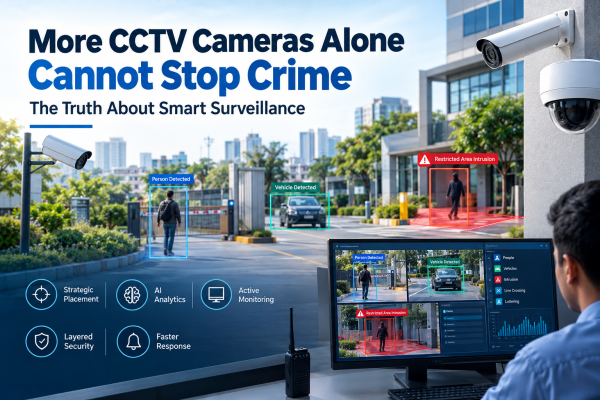
When a crime happens in public, people often ask a question.
This can happen on a busy street.
It can happen in a parking lot.
It can happen in a shop.
It can happen in a neighborhood.
Why aren’t there more CCTV cameras everywhere?
It seems logical that if more cameras are installed, there should be less crime. CCTV cameras can discourage certain criminal activities, provide evidence after an incident, and help security teams monitor important locations.
However, simply increasing the number of cameras does not automatically create a safer environment.
The real value of CCTV depends on where you place the cameras. It also depends on the technology they use. It depends on how someone monitors the footage. It also depends on how quickly someone responds to an alert.
Research over many decades has found that CCTV is linked to a modest drop in crime. The effects are stronger and more consistent in places like car parks and some residential areas. Systems with active monitoring and additional security measures have also tended to perform better than passive CCTV alone.
More Cameras Do Not Always Mean More Security
Imagine a large property with 100 CCTV cameras.
If many cameras point to the wrong areas, some have poor lighting, and others have blind spots, security may fail. Nobody may watch key alerts.
Now consider a smaller property with 20 strategically positioned cameras covering:
-
Main entrances
-
Emergency exits
-
Parking areas
-
Cash counters
-
Perimeter gates
-
Storage areas
-
Corridors
-
High-risk zones
The second system may provide more useful security despite having fewer cameras.
This is why CCTV planning is more important than simply counting cameras.
1. CCTV Needs Strategic Camera Placement
Camera placement can determine whether recorded footage is actually useful.
For example, a camera covering a building entrance should ideally provide a useful view of people entering and leaving. A parking-area camera may need a different field of view and low-light capability.
Important considerations include:
-
Camera height
-
Viewing angle
-
Distance from the subject
-
Lighting conditions
-
Blind spots
-
Lens selection
-
Required identification detail
-
Indoor or outdoor environment
Installing a high-resolution camera in the wrong position can still result in poor evidence.
2. CCTV Is Not a Replacement for Security Personnel
A common misconception is that once cameras are installed, they can completely replace security guards or other security measures.
CCTV can provide visibility, but people are still needed to interpret situations and respond appropriately.
This becomes particularly important when a camera detects suspicious activity. Someone must decide what to do.
They must decide if the event needs security to respond.
They must decide if it needs an alarm.
They must decide if someone should check the site.
They must decide if the right authorities need to be notified.
Research has found that CCTV systems with active monitoring can reduce crime more than passive systems. Passive systems only record footage.
3. Modern CCTV Is Becoming More Intelligent
Traditional CCTV systems primarily record video.
Modern AI-enabled CCTV systems can analyze video and identify specific events or objects.
Depending on the camera and software, intelligent surveillance may provide features such as:
Human Detection
The system can distinguish people from general movement, helping reduce unnecessary alerts.
Vehicle Detection
AI analytics can identify vehicles entering or moving through monitored areas.
Intrusion Detection
Virtual boundaries can be created around restricted zones. An alert can be generated when a person enters the defined area.
Line-Crossing Detection
A virtual line can be set up across a doorway, gate, road, or other area. It detects movement across a set boundary.
Loitering Detection
Some systems can identify when a person remains in a specified area longer than a configured period.
People Counting
Businesses can use people-counting technology to understand how many individuals enter or leave a location.
These technologies can make CCTV more proactive. However, their accuracy depends on camera placement and lighting. It also depends on scene conditions and system setup. The specific analytics technology used also matters.
4. CCTV Footage Is Valuable After a Crime
Even when a camera does not prevent an incident, recorded footage can be extremely useful for understanding what happened.
For example, CCTV footage may help establish:
-
When an incident occurred
-
How a person entered or exited
-
Whether a vehicle was involved
-
Which direction someone travelled
-
What happened immediately before an incident
-
Whether multiple people were involved
This makes CCTV valuable not only as a deterrent but also as an investigative tool.
However, useful evidence depends on having appropriate image quality, sufficient storage, correct timestamps, reliable recording, and properly positioned cameras.
5. There Are Significant Costs Behind Every Camera
Installing a CCTV camera is only the beginning.
A large surveillance system can require substantial investment in:
-
Cameras
-
DVRs or NVRs
-
Hard drives
-
Network switches
-
PoE infrastructure
-
Cables
-
Power backup
-
Internet connectivity
-
Monitoring screens
-
Software
-
Maintenance
-
Replacement equipment
-
Security personnel
Therefore, installing cameras in every possible location may not be the most efficient use of a security budget.
A better approach is to identify high-risk and high-value areas first.
6. Privacy Is an Important Consideration
More surveillance also creates questions about privacy.
Organizations using CCTV systems should consider who can access footage. They should also consider how recordings are stored. They should think about how long recordings are kept. They should consider how footage is shared.
For example, Delhi’s official CCTV framework talks have addressed storage, monitoring, access, sharing, and disposal of footage. They also cover evidentiary value, public notices, and privacy safeguards.
Therefore, a responsible CCTV strategy should consider both security and privacy.
7. CCTV Cannot Stop Every Crime
CCTV should not be viewed as a technology that makes crime impossible.
A camera may discourage opportunistic offenders, but determined individuals may still attempt criminal activity.
The effectiveness of CCTV can also vary according to the environment and type of crime. A systematic review found that CCTV led to a modest drop in crime. The strongest results were in car parks and some residential areas.
This is why CCTV works best as part of a broader security strategy.
What Should Be Used Alongside CCTV?
A strong security plan can combine CCTV with other measures such as:
CCTV + Access Control + Security Guards + Lighting + Alarm Systems + Perimeter Security
For example, a warehouse could use CCTV to watch its perimeter. It could use access control to limit entry. Security guards could respond to incidents. Alarms could quickly alert staff to unauthorized access.
This layered approach can provide stronger protection than relying on cameras alone.
Should Public Places Have More CCTV Cameras?
There is no universal number of cameras that every street, market, parking area, or public location needs.
The better approach is to identify locations where surveillance is most useful.
These may include:
-
High-crime areas
-
Parking facilities
-
Building entrances
-
Busy intersections
-
Public transport locations
-
Commercial markets
-
Residential society entrances
-
Industrial premises
-
Warehouses
-
Sensitive or restricted areas
The goal should be effective coverage rather than maximum camera count.
How Can Businesses Make CCTV More Effective?
Businesses planning a CCTV system should start with a security assessment.
Ask questions such as:
-
What areas need protection?
-
Where are the biggest security risks?
-
What needs to be identified on camera?
-
Is night vision required?
-
How long should footage be stored?
-
Is remote monitoring required?
-
Are AI analytics useful for the property?
-
Who will respond to alerts?
-
How will the system be maintained?
-
How will access to recorded footage be controlled?
Answering these questions before purchasing equipment can prevent unnecessary spending and improve the effectiveness of the overall system.
The Future of CCTV Is Smarter, Not Simply Bigger
The future of surveillance is unlikely to be about installing the maximum possible number of cameras.
Instead, modern security systems are increasingly focused on better coverage, intelligent analytics, faster alerts, easier video search, and integration with other security technologies.
AI can help security teams focus on important events instead of manually watching hours of video.
At the same time, good camera positioning, reliable recording, proper maintenance, cybersecurity, and trained personnel remain essential.
Final Thoughts
So, why don't we simply put CCTV cameras everywhere?
Because more cameras do not automatically equal more security.
A well-designed CCTV system should cover the right areas. It should use the right camera technology. It should provide clear images. It should record reliably. It should detect important events. It should be actively monitored. It should include an effective response plan.
CCTV research supports its use as one part of crime prevention. Evidence also shows it works best when targeted and combined with other measures. It is less effective as a standalone solution.
The objective should not be to have the most CCTV cameras.
The goal should be to place the right CCTV cameras in the right locations, backed by the right security plan.
That is what turns CCTV from a simple recording system into an effective modern security solution.