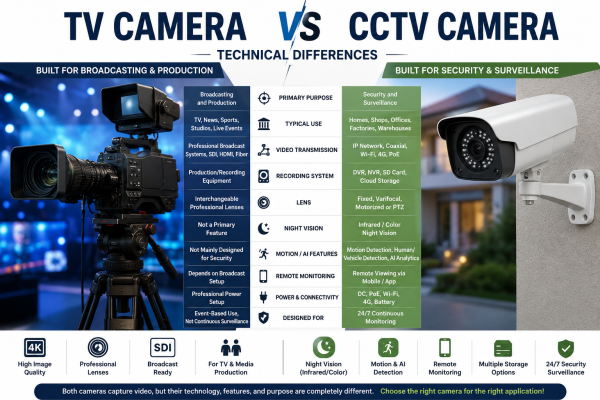
At first glance, a TV camera and a CCTV camera may seem to do the same job. Both capture video. However, their technology, design, connectivity, recording methods, and intended applications are significantly different.
A television camera is built mainly for broadcasting and professional video production, whereas a CCTV camera is designed for security surveillance and continuous monitoring. Understanding these differences is important when you choose the right camera for a home or business. It also helps for studios, shops, offices, and industrial sites.
This guide explains the technical difference between TV camera and CCTV camera in simple terms.
What Is a TV Camera?
A television camera is a professional video camera. It records footage for TV shows, news, sports, live events, concerts, and studio productions.
These cameras are designed to produce high-quality video that can be sent to professional production and broadcasting equipment. Many professional TV cameras support advanced sensors, interchangeable lenses, powerful optical zoom, manual controls, and professional video interfaces.
Common Applications of TV Cameras
TV cameras are commonly used for:
-
News broadcasting
-
Sports events
-
Television studios
-
Live concerts
-
Interviews
-
Political and public events
-
Entertainment programs
-
Professional video production
The main objective is to capture high-quality content for viewers.
What Is a CCTV Camera?
A CCTV camera, or Closed-Circuit Television camera, is a security camera. It monitors and records activity in a specific location.
Unlike a TV camera, a CCTV camera is usually part of a complete CCTV surveillance system. The camera can send footage to a DVR, NVR, memory card, cloud storage, or other recording platform.
Modern CCTV cameras can also include smart features like AI detection and motion detection. They may also offer night vision, remote viewing, and smart alerts.
Common Applications of CCTV Cameras
CCTV cameras are widely used in:
-
Homes
-
Shops
-
Offices
-
Schools
-
Warehouses
-
Factories
-
Parking areas
-
Hotels
-
Hospitals
-
Residential societies
-
Commercial buildings
The main objective is security, monitoring, and evidence recording.
TV Camera vs CCTV Camera: Main Technical Differences
Although both cameras capture video, they are optimized for different environments.
|
Technical Feature |
TV Camera |
CCTV Camera |
|
Primary purpose |
Broadcasting |
Security surveillance |
|
Main application |
TV, sports, news, studios |
Homes, shops, offices, factories |
|
Recording |
Production equipment |
DVR/NVR/cloud/SD card |
|
Night vision |
Usually not a core feature |
Common |
|
Infrared |
Generally uncommon |
Common in many models |
|
Lens |
Professional interchangeable lenses |
Fixed, varifocal, motorized, PTZ |
|
Motion detection |
Not primarily for security |
Common |
|
AI detection |
Limited security applications |
Increasingly common |
|
Remote monitoring |
Broadcast-dependent |
Common |
|
Power |
Professional production setup |
DC, PoE, Wi-Fi, 4G, etc. |
|
Weather protection |
Depends on model |
Common in outdoor CCTV models |
|
24/7 surveillance |
Not the primary purpose |
Designed for continuous monitoring |
1. Image Sensor and Image Processing
Professional TV cameras are designed to produce high-quality footage suitable for broadcasting. Their image sensors and processing systems are optimized for accurate color reproduction, dynamic range, motion handling, and professional production.
CCTV cameras also use advanced image sensors, but their processing is focused on security visibility.
For example, a CCTV camera may prioritize:
-
Clear facial details
-
License plate visibility
-
Low-light performance
-
Backlight compensation
-
Wide Dynamic Range
-
Noise reduction
-
Motion analysis
The processing requirements are therefore different even when both cameras offer high-resolution video.
2. Lens and Field of View
Lens technology is another important difference.
Professional TV cameras often use interchangeable broadcast lenses. These lenses can provide powerful optical zoom, allowing operators to capture subjects from considerable distances.
CCTV cameras are available with several lens configurations.
Fixed Lens CCTV Camera
A fixed lens gives a set viewing angle and works well when the camera position and coverage needs are known.
Varifocal CCTV Camera
A varifocal lens allows the installer to adjust the focal length and viewing angle according to the installation requirements.
PTZ CCTV Camera
A PTZ camera provides:
-
Pan
-
Tilt
-
Optical zoom
PTZ cameras are useful for monitoring larger areas where the camera needs to change its viewing direction.
3. Video Transmission
The transmission method is significantly different.
Television cameras are commonly connected to professional broadcast infrastructure. Depending on the setup, video may travel through professional video connections, fiber, wireless transmission systems, or production equipment.
CCTV cameras use surveillance-specific technologies.
Analog CCTV
Traditional analog CCTV cameras transmit video through coaxial cable to a DVR.
IP CCTV
Modern IP cameras transmit digital video over a network. They can connect to an NVR, network switch, router, or other compatible equipment.
PoE CCTV
Power over Ethernet allows compatible IP cameras to receive both power and data through a single Ethernet cable.
Wireless CCTV
Wi-Fi CCTV cameras can transmit video wirelessly while using a separate power source.
4G CCTV
SIM-based CCTV cameras can use cellular networks where a conventional wired internet connection is unavailable.
4. Recording Technology
Recording is central to a CCTV surveillance system.
A CCTV camera may store or send video to:
-
NVR
-
DVR
-
MicroSD card
-
NAS
-
Cloud storage
-
Hybrid storage
Depending on the system, users can search footage based on date, time, motion, person, vehicle, or other events.
Television cameras, meanwhile, generally send footage to a professional production or recording system. The footage may be edited, broadcast live, or archived for later production.
Therefore, the CCTV recording system is built around security requirements rather than television programming.
5. Night Vision Capabilities
One of the biggest advantages of CCTV cameras is their ability to operate in darkness.
Many CCTV cameras include infrared LEDs that illuminate the area using infrared light. The camera sensor can then capture the scene even when there is little or no visible light.
Modern CCTV cameras can offer:
-
IR night vision
-
Smart IR
-
Color night vision
-
Low-light technology
-
Full-color surveillance
-
White-light illumination
Professional television cameras can offer excellent low-light performance, but dedicated infrared security monitoring is generally not their primary function.
6. Motion Detection
Motion detection is an important CCTV feature.
A basic CCTV camera can identify movement within its field of view and trigger recording or an alert.
However, modern cameras can use more advanced algorithms to distinguish between different types of movement.
For example, an AI CCTV camera may identify:
-
A person
-
A vehicle
-
An animal
-
General movement
This can help reduce unnecessary notifications.
Television cameras generally do not have security-oriented motion detection as a central function.
7. AI-Based CCTV Surveillance
Artificial intelligence is changing modern security cameras.
An AI CCTV camera can analyze video footage and detect specific objects or activities.
Depending on the model, AI features may include:
-
Human detection
-
Vehicle detection
-
Intrusion detection
-
Line-crossing detection
-
Loitering detection
-
People counting
-
Object detection
-
Smart tracking
For example, a business can install an AI CCTV camera. It can send an alert when someone enters a restricted area.
This makes AI CCTV systems more useful for modern commercial and residential security.
8. Remote CCTV Monitoring
Modern CCTV cameras can be connected to the internet, allowing authorized users to view their cameras remotely.
A user can potentially:
-
Watch live footage
-
View recorded footage
-
Receive security alerts
-
Control PTZ cameras
-
Communicate through two-way audio
-
Monitor several cameras
This feature is useful for business owners who want to monitor their shops, offices, warehouses, or other properties. They can do this while away.
A TV camera may also transmit video remotely, but its remote transmission is generally part of a professional broadcasting workflow rather than a security monitoring platform.
9. Power and Installation
CCTV cameras are designed to be installed in fixed locations and operate for long periods.
IP cameras with PoE can simplify installation because one Ethernet cable can provide both data connectivity and power.
Depending on the camera, CCTV installations can also use:
-
DC power
-
PoE
-
Wi-Fi
-
4G/LTE
-
Battery systems
Professional TV cameras often require production-specific power and connectivity arrangements.
10. Outdoor Protection
Security cameras installed outside buildings need to withstand environmental conditions.
Outdoor CCTV cameras may include weather-resistant housings and protection against dust and water.
They are commonly installed around:
-
Gates
-
Parking areas
-
Building entrances
-
Factory premises
-
Warehouses
-
Residential compounds
A TV camera can also be used outdoors, especially for sports or news coverage, but its environmental protection depends on the particular camera and production equipment.
11. Continuous Operation
A major technical consideration is operating time.
CCTV cameras are designed for continuous surveillance. A security system can be configured for:
-
24/7 recording
-
Motion-based recording
-
Scheduled recording
-
Event-based recording
This makes CCTV cameras suitable for security applications where monitoring must continue day and night.
Television cameras are normally used during broadcasts, productions, or events rather than as permanent security monitoring devices.
Can a TV Camera Be Used as a CCTV Camera?
In some specialized situations, a professional TV camera can be connected to a monitoring or recording system. However, this does not necessarily make it a practical CCTV solution.
A dedicated CCTV camera includes features specifically designed for surveillance, such as:
-
Night vision
-
Motion detection
-
AI analytics
-
Continuous recording
-
DVR/NVR integration
-
Remote mobile monitoring
-
Outdoor protection
-
Security alerts
For most homes and businesses, using a purpose-built CCTV security camera is more practical than adapting a professional television camera.
Which Camera Should You Choose?
The right camera depends on your requirements.
Choose a TV Camera If You Need:
-
Television broadcasting
-
Professional video production
-
Sports coverage
-
Studio recording
-
News reporting
-
Live event production
-
High-quality broadcast footage
Choose a CCTV Camera If You Need:
-
Home security
-
Shop surveillance
-
Office monitoring
-
Factory security
-
Warehouse monitoring
-
Parking surveillance
-
Night-time monitoring
-
Remote security access
-
24/7 video recording
-
AI-based security alerts
Important Factors When Buying a CCTV Camera
If you are purchasing a CCTV camera for security, do not select a model only because it has a higher megapixel count.
Consider these factors:
Resolution
Choose Full HD, 4MP, 5MP, 8MP, or higher according to the level of detail required.
Night Vision
Check the camera's infrared range and low-light performance if the location needs nighttime surveillance.
Lens
Select a fixed lens for standard coverage or a varifocal/PTZ camera when you need adjustable coverage.
Storage
Consider whether you need an NVR, DVR, SD card, NAS, or cloud-based recording system.
AI Features
Human detection, vehicle detection, intrusion detection, and other AI features can improve the usefulness of modern CCTV systems.
Connectivity
Choose wired IP, PoE, Wi-Fi, or 4G connectivity depending on your installation environment.
Weather Resistance
For outdoor applications, select a CCTV camera designed for outdoor installation.
Final Verdict
The difference between a TV camera and CCTV camera is not simply about image quality. Their entire design philosophy is different.
A television camera is optimized for broadcasting, professional production, live events, sports, and media creation. A CCTV camera is optimized for security surveillance, continuous monitoring, recording, remote access, night vision, and intelligent detection.
If your goal is to produce professional video content, a television camera is the appropriate choice. If your goal is to protect a property and monitor activities, a dedicated CCTV camera system is generally the better solution.
Understanding the technical differences before purchasing a camera can help you select the right equipment for your specific application.