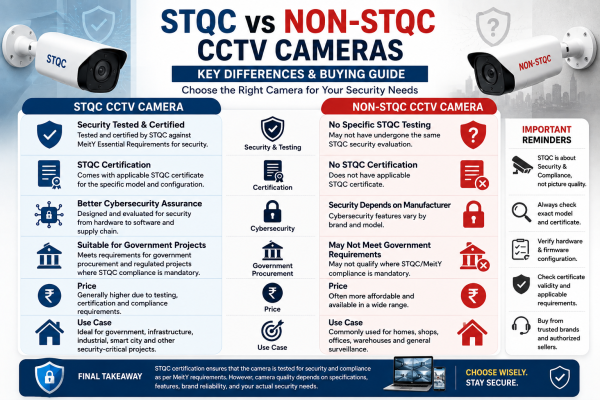
When buying CCTV cameras in India, buyers often see terms like STQC CCTV camera. Buyers may also see STQC-certified camera. They may also see non-STQC camera. While both types can be used for video surveillance, they can differ a lot in key areas.
These include security checks, certification, regulatory needs, and fit for specific projects.
Many people believe that an STQC camera automatically provides better picture quality than a non-STQC camera. This is not correct. STQC compliance mainly relates to specific security and certification requirements. Features like resolution, night vision, lens quality, and storage depend on the camera model.
This guide explains the difference between STQC and non-STQC CCTV cameras. It helps you choose which option suits your requirements.
What Does STQC Mean for CCTV Cameras?
STQC stands for Standardisation Testing and Quality Certification Directorate, which operates under India's Ministry of Electronics and Information Technology (MeitY).
STQC provides testing and certification services for various electronic and IT products. CCTV cameras are included within the applicable IoT System Certification Scheme and related security requirements.
For CCTV products, the applicable security requirements are based on Essential Requirements (ERs) notified by MeitY. These requirements aim to keep CCTV products secure. They also cover related hardware and firmware. They include interfaces and supply-chain factors too.
What Is an STQC CCTV Camera?
An STQC CCTV camera is a camera model or product setup. It is tested against security needs under the relevant certification framework.
The important word here is specific.
A manufacturer may have some STQC-certified camera models. Other models from the same manufacturer may not be certified.
Therefore, buyers should always check the exact model number and the right certificate. Do not assume every camera from a brand is STQC certified.
STQC maintains information on certified products and CCTV certification procedures through its IoTSCS framework.
What Is a Non-STQC CCTV Camera?
A non-STQC CCTV camera does not have the required STQC certification.
It also lacks the security evaluation documents for the relevant requirement.
However, this does not mean that every non-STQC camera is low quality.
A non-STQC camera may still offer:
-
2MP, 4MP, 5MP, 8MP or higher resolution
-
Infrared night vision
-
Full-color night vision
-
Motion detection
-
AI-based detection
-
Mobile monitoring
-
Remote access
-
NVR/DVR compatibility
-
Two-way audio
-
Weather-resistant construction
The difference is that the product should not be shown as having the applicable STQC certification. This applies unless the right documents exist.
STQC vs Non-STQC CCTV Camera: Main Differences
|
Factor |
STQC CCTV Camera |
Non-STQC CCTV Camera |
|
Security evaluation |
Evaluated against applicable security requirements |
No applicable STQC security certification |
|
Certification |
Relevant certification/test documentation available |
Applicable STQC certification unavailable |
|
Cybersecurity assurance |
Provides documented evaluation against specified requirements |
Depends on manufacturer and product |
|
Government projects |
Relevant where applicable requirements are specified |
May not meet projects requiring STQC/MeitY compliance |
|
Image quality |
Depends on camera specifications |
Depends on camera specifications |
|
Night vision |
Depends on model |
Depends on model |
|
Price |
Can be higher because of compliance/testing |
Often available across a wider price range |
|
Home use |
Suitable if required or preferred |
Suitable where compliance is not required |
|
Business use |
Suitable for security-critical applications |
Suitable for many general surveillance applications |
Is an STQC Camera Better Than a Non-STQC Camera?
It depends on what you mean by "better."
If you are comparing security certification and documented compliance, an applicable STQC-certified camera has an important advantage.
If you are comparing video quality, however, STQC certification alone does not tell you which camera is better.
For example, a non-STQC camera may have a higher resolution.
It may also work better in low-light conditions than an STQC-certified camera.
Similarly, an STQC camera can have different specifications from another STQC camera.
Therefore, don't select a CCTV camera based only on the STQC label. Look at the complete specification and the requirements of your project.
Why Is Cybersecurity Important in CCTV Cameras?
Modern IP CCTV cameras are connected devices. They may communicate with:
-
NVRs
-
Routers
-
Local networks
-
Mobile applications
-
Cloud services
-
Monitoring software
This means CCTV security is no longer only about preventing physical damage to the camera. Cybersecurity has also become an important consideration.
The applicable STQC/MeitY CCTV security requirements address areas such as hardware, firmware, interfaces, secure development practices, and supply-chain security. STQC's CCTV certification procedure also requires manufacturers to demonstrate compliance through technical documentation and security-related controls.
For organizations operating large CCTV networks, these considerations can be particularly important.
STQC Cameras for Government and Regulated Projects
STQC compliance becomes especially important when CCTV cameras are being purchased for projects where applicable government procurement or regulatory requirements specify security compliance.
MeitY has notified CCTV cameras under the Public Procurement (Preference to Make in India) Order (PPP-MII). It has also notified them under the applicable Compulsory Registration Order (CRO) framework for specified security requirements. MeitY’s February 2026 clarification says CCTV security testing reports under the relevant framework come from STQC.
They may also come from another agency notified by MeitY.
Therefore, if you are purchasing CCTV cameras for a government tender, public-sector project, or another regulated application, you should carefully check the tender and applicable requirements before selecting a product.
Important: Not Every STQC Certificate Means the Same Thing
This is an important point for CCTV buyers.
STQC issued a clarification in August 2026. It said older certificates under the IoT System Certification Scheme are not automatically valid. This applies to the PPO for cameras. Products must be validated against the Essential Requirements. These requirements are listed in the relevant MeitY notification.
This means that simply seeing the words "STQC Certified" is not enough.
You should verify:
-
Certificate number
-
Exact camera model
-
Manufacturer/OEM
-
Applicable certification scheme
-
Security requirements covered
-
Product configuration
-
Certificate validity
-
Whether the certification satisfies your particular procurement requirement
Does STQC Certification Improve CCTV Image Quality?
No.
STQC certification and image quality are separate considerations.
The image quality of a CCTV camera depends on factors such as:
Camera Resolution
A higher resolution can provide more image detail, but resolution alone does not determine overall image quality.
Image Sensor
The sensor has a major impact on low-light performance, color reproduction, and image clarity.
Lens
Lens focal length and quality set the camera’s field of view.
They also affect how much detail the camera captures at different distances.
Night Vision
Infrared LEDs, sensor sensitivity, image processing, and camera design affect nighttime performance.
WDR
Wide Dynamic Range can help the camera handle scenes containing both very bright and dark areas.
Therefore, an STQC-certified camera should still be evaluated for these technical features.
When Should You Consider an STQC Camera?
An STQC-compliant CCTV camera may be worth considering when:
-
Your project requires STQC/MeitY security compliance.
-
You are responding to a government tender.
-
You are installing CCTV for a security-sensitive organization.
-
Documented cybersecurity evaluation is important.
-
Supply-chain security is an important consideration.
-
Your customer specifically requires applicable certification.
In these situations, certification can be an important part of the purchasing decision.
When Can a Non-STQC Camera Be Suitable?
Non-STQC cameras can be suitable for many applications where the applicable STQC requirement does not apply.
For example, a homeowner may primarily need:
-
Good video quality
-
Night vision
-
Mobile viewing
-
Motion alerts
-
Local recording
-
Reliable warranty
-
Affordable installation
Similarly, a small shop may need a simple CCTV system. It can monitor entrances and counters. It can also cover storage areas and other key locations.
In such cases, buyers should assess the camera based on real security needs and relevant rules. They should not assume STQC certification is always required.
STQC Camera vs Non-STQC Camera: What About Price?
STQC-certified products may cost more because manufacturers have to invest in testing, documentation, security controls, certification, and compliance processes.
However, price should not be the only factor.
A CCTV system should be evaluated according to its total value, including:
-
Camera performance
-
Recorder compatibility
-
Installation
-
Warranty
-
Maintenance
-
Cybersecurity
-
Storage
-
After-sales support
-
Required certification
For a government project, choosing a cheaper camera without the required certification can cause bigger problems later.
How to Verify an STQC CCTV Camera Before Buying
Before purchasing, ask the seller or manufacturer for the relevant documentation.
Check the following:
1. Exact model number
Make sure the model supplied is the same model covered by the certificate.
2. Certificate number
Ask for the relevant STQC documentation rather than relying only on verbal claims.
3. Applicable requirements
Confirm that the certificate addresses the requirements applicable to your project.
4. Hardware and firmware configuration
Changes to important components or software may affect the evaluated configuration.
5. Certificate validity
Check whether the certification or test report remains applicable.
6. Manufacturer details
Verify that the manufacturer and product information match the documentation.
STQC provides an official certified-product listing for products evaluated against the applicable Essential Requirements.
Common Misconceptions About STQC Cameras
Myth 1: STQC means the camera has the best picture quality.
Fact: STQC certification is not a rating of image quality.
Myth 2: Every camera from an STQC-certified brand is STQC certified.
Fact: Certification should be checked for the specific product/model and applicable requirements.
Myth 3: Non-STQC means the camera is poor quality.
Fact: A non-STQC camera can still have excellent video and security features.
Myth 4: STQC is only about camera resolution.
Fact: The relevant requirements focus on security and compliance rather than simply megapixels.
Myth 5: Any document marked STQC automatically satisfies every government requirement.
Fact: The applicable certification scheme and MeitY requirements must be checked. STQC issued a clarification in August 2026. It warned that earlier IoTSCS certificates are not automatically valid for camera PPO. Such certificates must be validated against the relevant Essential Requirements.
Which CCTV Camera Should You Buy?
The answer depends on the application.
For a home, focus on image quality, night vision, mobile monitoring, storage, reliability, and budget, while also considering applicable cybersecurity and regulatory requirements.
For a shop or office, consider camera coverage, recording, remote access, storage, night vision, and after-sales support.
For a factory or warehouse, consider durability, coverage, low-light performance, network infrastructure, and security requirements.
For a government or regulated project, carefully verify the applicable STQC/MeitY certification and tender requirements before purchasing.
Final Conclusion
The difference between STQC and non-STQC CCTV cameras is primarily related to security evaluation, certification, and compliance, rather than simply video quality.
An STQC-certified camera can provide documented assurance that the particular product has been evaluated against applicable security requirements. This can be particularly important for government procurement and security-sensitive projects.
A non-STQC camera is not automatically inferior. It may still provide excellent surveillance for homes, shops, offices, warehouses, and other uses.
This applies where the STQC requirement is not mandatory.
The best approach is to first identify your requirements and then compare certification, cybersecurity, image quality, night vision, storage, compatibility, warranty, installation, and price.
Most importantly, if someone claims a CCTV camera is “STQC certified,” check the exact model and valid certificate. Do not rely only on the seller’s claim.
For CCTV buyers in India, knowing STQC requirements can help you make a better choice.
It can also help you avoid picking a camera that does not suit your project needs.