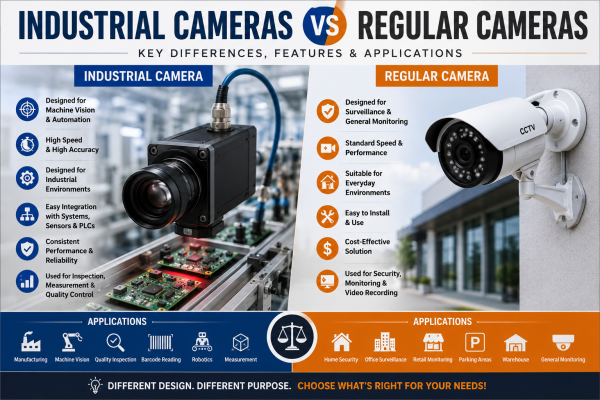
Cameras play an important role in security, manufacturing, automation, retail, logistics, and many other industries. However, choosing a camera is not simply about selecting the highest resolution or the latest features. The right camera depends on how and where it will be used.
A major distinction is between industrial cameras and regular cameras. While both capture images or video, their design, features, capture methods, and uses can differ a lot.
In this blog, we will explore the differences between industrial and regular cameras. We will explain their key features. We will also help you choose the best camera for your needs.
What Is an Industrial Camera?
An industrial camera is a specialized camera designed for industrial imaging, machine vision, automation, and inspection applications. These cameras capture clear, consistent images for software analysis or use with automated machines.
Industrial cameras are common in factories and production areas. They inspect products, find defects, measure objects, read codes, and guide robotic systems.
Some common industrial camera applications include:
-
Automated quality inspection
-
Machine vision
-
Product defect detection
-
Barcode and QR code reading
-
Robotic guidance
-
Assembly verification
-
Product measurement
-
Packaging inspection
-
Manufacturing automation
-
Production-line monitoring
The main goal of an industrial camera is not simply to record video. It is to provide reliable image data for industrial processes.
What Is a Regular Camera?
A regular camera is a general-purpose camera designed for photography, video recording, surveillance, or everyday monitoring.
Examples include digital cameras, smartphone cameras, webcams, and standard CCTV security cameras.
Regular cameras are commonly used in:
-
Homes
-
Offices
-
Shops
-
Schools
-
Warehouses
-
Parking areas
-
Commercial buildings
-
Outdoor locations
For security, regular CCTV cameras can offer high-definition video, night vision, motion detection, remote viewing, and recording.
Industrial Cameras vs Regular Cameras: Major Differences
Although industrial and standard cameras both capture images, they are designed for different needs.
1. Different Design Objectives
Industrial cameras are designed primarily for precision and automation.
Regular cameras are designed mainly for general imaging, photography, or surveillance.
For example, an industrial camera may need to check a circuit board.
It can confirm whether a small component is in the correct position. A CCTV camera, on the other hand, may simply need to record activity inside the same manufacturing facility.
2. Image Consistency
Consistent image capture is extremely important in industrial applications.
When an automated system examines thousands of products, changes in exposure, brightness, or image timing can affect inspection accuracy. Industrial cameras provide greater control over image acquisition to help maintain consistent results.
Regular cameras often use automatic settings to make photography and surveillance easier for users. This is convenient for everyday applications but may not provide the precise control required for machine vision.
3. High-Speed Image Capture
Production lines can move extremely quickly. An industrial camera needs to capture images without missing important details.
Many industrial cameras support high frame rates and precise triggering. They can work with sensors that tell the camera exactly when an image should be captured.
This is useful when inspecting products moving on conveyor belts.
Regular cameras can also provide high-quality video, but their operation is generally not optimized for precise industrial inspection.
4. Global Shutter vs Rolling Shutter
Shutter technology is an important consideration when comparing industrial cameras vs regular cameras.
Industrial vision cameras frequently use global shutter sensors. A global shutter captures the image across the sensor at about the same time. It reduces distortion when objects move quickly.
A rolling shutter captures different portions of the image at slightly different times. Fast-moving objects may therefore appear distorted.
For applications involving fast production machinery, moving components, or high-speed inspection, global shutter technology can be particularly useful.
5. Triggering and Synchronization
Industrial cameras can often be synchronized with external equipment.
A sensor can detect a product, trigger the camera, and start the image acquisition at precisely the required moment. This allows cameras to work as part of an automated production system.
This capability is particularly important in machine vision systems, where timing can affect inspection accuracy.
Regular cameras usually work on their own and may not support the same level of external triggering and sync.
6. Integration With Automation
Industrial cameras can be integrated with a wide range of industrial equipment, including:
-
PLCs
-
Sensors
-
Industrial PCs
-
Robots
-
Conveyor systems
-
Machine vision software
-
Automated inspection equipment
This makes them an important component of modern manufacturing and Industry 4.0 systems.
Regular cameras are usually easier to install for general surveillance but are not necessarily designed for complex industrial automation.
7. Continuous Operation
Industrial production may continue for many hours every day. Cameras used for automated inspection may need to capture images continuously throughout the production process.
Industrial cameras are designed for these types of applications, where reliable and repeatable image acquisition is important.
Regular cameras can also work for long-term security monitoring. But their design goals may differ from machine vision cameras.
Industrial Camera vs CCTV Camera
The terms industrial camera and CCTV camera are sometimes used the same way.
However, they usually refer to different technologies and uses.
A CCTV camera is primarily designed for security surveillance. It allows users to monitor and record activity around a property or facility.
An industrial camera is primarily designed for machine vision and automated inspection.
For example:
CCTV camera:
Monitors employees, visitors, entrances, equipment, and warehouse areas.
Industrial camera:
Checks whether products are correctly assembled, measures components, or detects manufacturing defects.
A factory may actually use both types of cameras because security monitoring and automated inspection are different requirements.
Where Are Industrial Cameras Used?
Industrial cameras are used in a wide range of industries.
Manufacturing
Manufacturers use industrial cameras for automated inspection, defect detection, product measurement, and assembly verification.
Automotive
Automotive manufacturers use machine vision cameras to inspect components and identify production defects.
Electronics
Industrial cameras can inspect circuit boards and small electronic components for incorrect placement, missing parts, or visible defects.
Food Processing
Vision systems can check product size, shape, packaging, labels, and positioning.
Pharmaceutical Manufacturing
Industrial cameras can assist with packaging inspection, label verification, product counting, and quality control.
Logistics
Industrial vision cameras can help read barcodes, identify packages, count products, and support automated sorting systems.
Benefits of Industrial Cameras
Using an industrial camera can provide several advantages.
Improved Quality Control
Automated camera inspection can help identify defects consistently during production.
Faster Inspection
Industrial cameras can inspect products while they are moving through production lines.
Reduced Human Error
Automated imaging reduces the need for repetitive manual visual inspection.
Better Automation
Industrial cameras can work with robots, sensors, PLCs, and machine vision software.
Consistent Results
Precise image acquisition can help maintain consistent inspection standards.
Increased Productivity
Automated inspection can help businesses identify problems quickly and reduce production delays.
Benefits of Regular Cameras
Regular cameras remain a practical choice for many applications.
They are suitable for:
-
Home security
-
Office surveillance
-
Retail monitoring
-
Warehouse security
-
Parking surveillance
-
Visitor monitoring
-
General video recording
-
Property protection
A modern CCTV camera for a home or business can let you monitor it remotely from your phone. It can detect motion. It can record in HD. It can see at night. It can send real-time alerts.
For these applications, an industrial camera would often provide capabilities that are unnecessary.
How to Choose the Right Camera
Before purchasing a camera, first determine the primary purpose of the system.
An industrial camera is generally the better option when you require:
-
Machine vision
-
Automated quality inspection
-
High-speed imaging
-
Product measurement
-
Defect detection
-
Robotic guidance
-
Production-line monitoring
-
Automated manufacturing
A regular camera or CCTV camera is generally more suitable for:
-
Home security
-
Office surveillance
-
Retail security
-
Warehouse monitoring
-
Property surveillance
-
Visitor monitoring
-
General video recording
Other factors such as resolution, frame rate, shutter technology, lens selection, lighting, connectivity, environmental conditions, storage, and software compatibility should also be considered.
Why the Right Camera Matters
Choosing a camera based only on resolution can lead to the wrong decision.
For example, a high-resolution CCTV camera may produce great video. However, it may still be unsuitable for high-speed machine vision. Similarly, an industrial camera may be unnecessarily complex and expensive for basic home surveillance.
The best camera is the one that matches the requirements of the application.
Final Thoughts
The difference between industrial cameras and regular cameras is primarily related to their design, purpose, and operating requirements.
Industrial cameras are built for machine vision, automation, manufacturing, high-speed imaging, measurement, and quality inspection. Regular cameras are designed for photography, surveillance, video recording, and everyday monitoring.
If your business requires automated inspection or precise image analysis, an industrial camera can provide the performance and integration capabilities needed. For home, office, retail, and general security needs, a reliable CCTV or surveillance camera is often the best choice.
By knowing the difference between industrial and regular cameras, businesses can choose the right imaging solution. This helps improve efficiency and avoids paying for features they do not need.