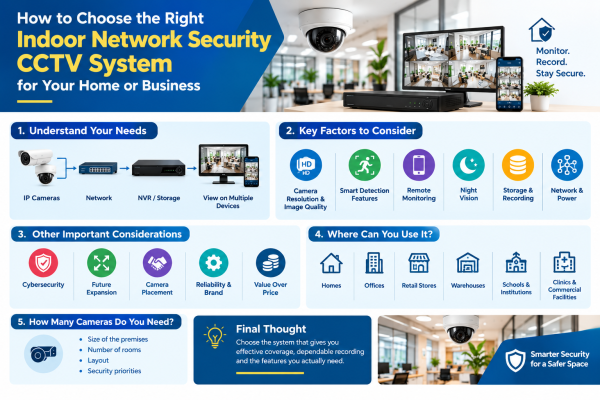
Indoor security is just as important as outdoor security. Homes, offices, retail stores, schools, warehouses, clinics, and other commercial spaces can benefit from reliable surveillance. A well-designed indoor CCTV security system helps you watch key areas. It records activity. It also helps you respond faster to security concerns.
With so many CCTV cameras and network surveillance solutions available today, choosing the right system can sometimes be confusing. The cheapest camera is not always the best choice, and a high-priced camera may include features you do not actually need.
This guide explains the key reasons to choose a good indoor network CCTV system and what you should consider before purchasing one.
What Is an Indoor Network CCTV System?
An indoor network CCTV system generally uses IP cameras connected through a computer network. The cameras transmit video data to an NVR (Network Video Recorder), storage system, or other compatible surveillance platform.
Depending on the equipment, users can view live video locally or remotely. They can use a computer, smartphone, or tablet.
A network-based system can be especially useful when multiple cameras need to be monitored from a central location.
1. Protect Important Indoor Areas
A major reason to install indoor CCTV cameras is to monitor areas where security matters most.
For a business, these could include:
-
Main entrances
-
Reception areas
-
Cash counters
-
Storage rooms
-
Corridors
-
Work areas
-
Restricted sections
For homes, cameras may be useful in entrances, hallways, garages, or other suitable areas.
The objective should be to identify important locations and install cameras where they provide meaningful coverage.
2. Get Clearer Security Footage
A good CCTV system should provide footage that is useful when you actually need to review it.
Camera resolution is one factor. Image quality also depends on the sensor and lens. It also depends on lighting, image processing, and camera placement.
For indoor surveillance, look for features such as:
-
High-definition video
-
Wide dynamic range
-
Good low-light performance
-
Suitable viewing angles
-
Digital noise reduction
-
Appropriate lens selection
Instead of choosing a camera based only on megapixels, consider if it provides enough detail for the area.
3. Monitor Cameras Remotely
One of the biggest advantages of network CCTV is remote monitoring.
When the system is set up for secure remote access, approved users can view live camera feeds on a smartphone or computer.
For example, a business owner can check the shop after hours. A homeowner can view activity at an entrance while away.
Remote monitoring adds convenience and gives users greater awareness of what is happening on the premises.
4. Improve Security at Night
Indoor areas can still require surveillance after normal working hours.
Cameras with low-light technology or infrared night vision can keep monitoring when there is little or no light.
However, night vision performance varies between camera models. Before purchasing, consider the actual lighting conditions of the room and the distance that needs to be monitored.
5. Use Smart Detection Features
Modern network cameras can offer intelligent detection features that make surveillance more useful.
Depending on the camera and recorder, these may include:
-
Motion detection
-
Human detection
-
Intrusion detection
-
Line-crossing detection
-
Camera tampering alerts
-
Event notifications
These features can help users focus on events that may require attention instead of manually reviewing hours of footage.
6. Centralized Recording With an NVR
When several IP cameras are installed, an NVR can provide centralized recording and management.
Instead of checking every camera individually, users can access multiple camera feeds through one system.
An NVR can also provide features such as:
-
Continuous recording
-
Event-based recording
-
Playback
-
Search
-
Backup
-
User management
The NVR should be selected according to the number of cameras, required resolution, storage needs, and future expansion plans.
7. Choose Storage According to Your Requirements
Recording storage is an important part of any CCTV installation.
The amount of storage required depends on several factors, including:
-
Number of cameras
-
Camera resolution
-
Recording schedule
-
Frame rate
-
Compression technology
-
Number of days of footage required
If you need several weeks of recordings, you may need much more storage than a system meant for only a few days.
Planning storage before installation helps avoid problems later.
8. Reduce Blind Spots With Proper Camera Placement
Even an expensive CCTV camera cannot provide effective security if it is installed in the wrong location.
Before installation, identify:
-
Entry and exit points
-
High-value areas
-
Frequently used pathways
-
Areas with limited visibility
-
Potential blind spots
The camera's field of view should match the area being monitored.
For larger rooms, multiple cameras may be more effective than trying to cover everything with one camera.
9. Consider Network and Power Requirements
Because IP cameras operate through a network, the supporting infrastructure matters.
Depending on the system, you may need:
-
Ethernet cabling
-
Network switches
-
PoE switches
-
NVR
-
Suitable power arrangements
-
Router/network connectivity
PoE (Power over Ethernet) can make some setups easier. It lets compatible cameras get power and data through a single Ethernet cable.
A properly planned network can make the CCTV system more stable and easier to maintain.
10. Pay Attention to Cybersecurity
Network-connected CCTV cameras should be protected against unauthorized access.
Good security practices include:
-
Changing default passwords
-
Using strong and unique passwords
-
Keeping supported firmware updated
-
Limiting unnecessary remote access
-
Creating appropriate user permissions
-
Securing the network
Cybersecurity should be considered when selecting both cameras and recording equipment, particularly for systems that can be accessed remotely.
11. Plan for Future Expansion
Your security requirements may increase as your home or business grows.
For example, a business may initially need four cameras but later require additional cameras for a new office, storage area, or sales floor.
Choosing an NVR, network infrastructure, and camera system with reasonable expansion capacity can make future upgrades easier.
12. Choose Reliability Over Price Alone
Price is naturally an important consideration, but it should not be the only deciding factor.
A CCTV system is a long-term security investment. Consider:
-
Camera reliability
-
Recording performance
-
Warranty
-
Product availability
-
Technical support
-
Replacement options
-
Overall system compatibility
A slightly higher upfront cost can offer better value if the system is more reliable and easier to maintain.
Where Can Indoor Network CCTV Cameras Be Used?
Indoor network CCTV systems can be used in many different environments, including:
Homes
Monitor entrances, hallways, garages, and other appropriate indoor areas.
Offices
Monitor reception areas, corridors, workspaces, and restricted areas.
Retail Stores
Monitor entrances, sales areas, counters, and stock rooms.
Warehouses
Keep an eye on storage areas, access points, and internal movement.
Schools and Institutions
Monitor suitable common areas and entry points while respecting privacy requirements.
Clinics and Commercial Facilities
Monitor entrances, waiting areas, corridors, and other appropriate spaces.
How Many Indoor CCTV Cameras Do You Need?
There is no universal number of cameras that works for every property.
The required number depends on:
-
Size of the premises
-
Number of rooms
-
Layout
-
Security priorities
-
Camera viewing angle
-
Number of entrances
-
Required level of detail
A professional site assessment can help identify important coverage areas and minimize unnecessary cameras.
Indoor CCTV Is More Than Just Recording
A modern CCTV system should not be viewed simply as a collection of cameras.
The cameras, NVR, storage, network, power supply, remote-access configuration, and cybersecurity practices all work together.
A weak component can affect the performance of the entire surveillance system. That’s why it is important to plan the full system, instead of buying cameras based only on price or resolution.
Conclusion
A good indoor network security CCTV system offers reliable surveillance, remote monitoring, and high-quality recording. It also supports smart detection and centralized management for homes and businesses.
When choosing a system, focus on the actual requirements of your property. Consider camera resolution, field of view, night vision, storage, networking, smart features, cybersecurity, reliability, and future expansion.
The right CCTV system is not necessarily the one with the most features. It is the one that provides effective coverage, dependable recording, and useful security features for your specific indoor environment.