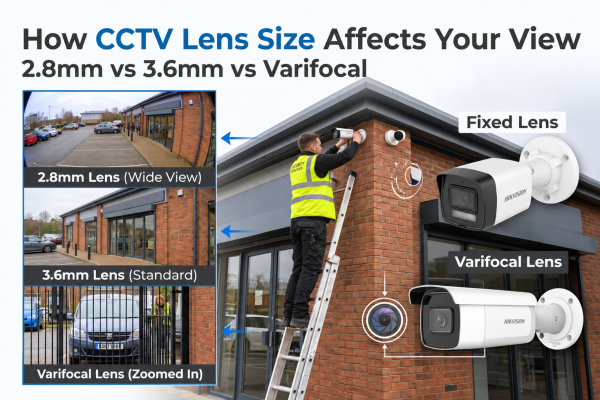
Many property owners install high-resolution 4MP or 5MP security cameras only to realize later that faces near the main gate look too small or vehicle number plates at the end of the driveway are unreadable. In most cases, the issue is not the camera’s megapixel rating—it is choosing the wrong lens type and focal length.
In professional surveillance planning, installers use the DORI standard (Detect, Observe, Recognize, Identify) to match a lens to its exact job. Understanding how fixed, manual varifocal, and motorized varifocal lenses behave in real-world conditions ensures you capture usable evidence rather than blurry silhouettes.
Understanding Focal Length: Wide View vs. Long-Distance Detail
A CCTV lens measured in millimeters (mm) acts just like the zoom on a camera:
-
Smaller millimeter numbers (2.8mm – 3.6mm) give a wide field of view (roughly 80° to 105°), covering an entire room or storefront while keeping objects appearing smaller and farther away.
-
Larger millimeter numbers (6mm – 12mm+) narrow the field of view (down to roughly 20° to 45°), concentrating all of the camera’s pixels onto a tight zone such as an entry gate, cash counter, or parking lane.
Because every property has both wide indoor areas and narrow distant entry points, selecting the right lens mechanism is essential.
1. Fixed Lens Cameras: Best for Eliminating Close-Range Blind Spots
A fixed lens CCTV camera comes permanently calibrated at a single focal length—most commonly 2.8mm or 3.6mm.
-
Where a 2.8mm Fixed Lens Shines: Ideal for compact indoor spaces, retail shop floors, corridors, elevators, and small front porches. Its ultra-wide angle minimizes corner blind spots so one camera can monitor an entire room.
-
Where a 3.6mm Fixed Lens Shines: Slightly narrower than 2.8mm, a 3.6mm lens reduces fish-eye edge distortion and gives slightly better facial clarity at distances of 5 to 10 meters—making it great for main doors, staircases, and small office receptions.
-
The Limitation: If you mount a 2.8mm fixed camera 20 meters away from a gate, relying on digital zoom in your mobile app will only magnify pixelated blocks.
-
Common Models: Hikvision DS-2CD1063G2-LIU (2.8mm), Dahua HFW1439TL1-A-IL (2.8mm), and Hikvision DS-2CE5AD0T-IRPF (3.6mm).
2. Manual Varifocal Cameras: Precision Framing for Fixed Zones
A manual varifocal camera bridges the gap between wide coverage and targeted zoom, typically offering an adjustable 2.8mm to 12mm optical range.
-
Why Optical Zoom Matters: During installation, the technician physically adjusts the lens rings to frame the exact area you care about—such as a shop entrance, loading bay, or boundary gate—while preserving 100% of the sensor's native clarity.
-
Best Real-World Scenarios: Ground-floor commercial entrances, clinic waiting areas, school gates, and medium-sized compounds where the camera sits at an accessible height and the target zone never moves.
-
The Trade-Off: Because adjustment requires opening or accessing the lens screws manually, it is best suited for "set-it-and-forget-it" installations rather than sites whose layouts frequently change.
-
Common Models: CP PLUS CP-UNC-TA41L3-V3 (2.8–12mm), Hikvision DS-2CE16D0T-VFIR3F (2.8–12mm), and Dahua HAC-HFW1200TH-I4 (2.7–12mm).
3. Motorized Varifocal Cameras: Instant Adaptation & Sharp Night Focus
A motorized varifocal camera offers the same optical zoom range (such as 2.8–12mm or 2.7–13.5mm), but replaces manual screws with internal micro-motors and automatic focus.
-
Solving Day-to-Night Focus Drift: Infrared (IR) light focuses slightly differently than visible daylight. Motorized varifocal cameras automatically recalibrate focus when switching between day and night modes, keeping distant subjects sharp 24/7.
-
Zero-Ladder Reconfiguration: If a warehouse rearranges storage racks, a factory shifts its entry lane, or a homeowner wants to zoom tighter onto a parked vehicle, the angle can be adjusted in seconds from a mobile app or NVR.
-
Best Real-World Scenarios: High warehouse ceilings, industrial sheds, apartment society gates, long driveways (15–30 meters), and retail billing counters.
-
Common Models: CP PLUS CP-UNC-TA41PL5C-VMD-LQ (2.7–13.5mm), TP-Link InSight S345ZI (2.7–13.5mm), Hikvision DS-2CD2643G2-LIZS2U (2.8–12mm), and Hikvision DS-2CD2783G2-IZS (2.8–12mm).
Real-World Placement Guide by Property Type
|
Property Location |
Recommended Lens Type |
Why It Works Best |
|
Bedrooms, Living Rooms & Hallways |
Fixed (2.8mm) |
Captures wall-to-wall coverage with minimal blind spots at low cost |
|
Shop Floor & Office Cabin |
Fixed (2.8mm or 3.6mm) |
Covers wide seating or display aisles clearly within 8–10 meters |
|
Billing / Cash Counter |
Motorized Varifocal (2.8–12mm) |
Zooms tightly onto hands, cash drawers, and customer faces |
|
Reachable Ground-Level Gate |
Manual Varifocal (2.8–12mm) |
Framed once on installation day to capture visitor faces clearly |
|
Long Driveway or Apartment Gate |
Motorized Varifocal (2.7–13.5mm) |
Optical zoom pulls distant vehicles and faces closer with autofocus |
|
Warehouse & High Factory Ceiling |
Motorized Varifocal (2.7–13.5mm) |
Avoids ladder rentals whenever aisles or storage zones are reconfigured |
4 Golden Rules Before Finalizing Your CCTV Order
-
Match Lens to Distance, Not Just Resolution: A 4MP camera zoomed optically to 12mm will identify a face at 20 meters far better than an 8MP camera stuck on a wide 2.8mm fixed lens.
-
Use a Hybrid Setup: Combine affordable fixed-lens cameras for indoor rooms with motorized varifocal cameras at main gates and perimeters to balance budget and security.
-
Avoid Relying on Digital Zoom for Evidence: Digital zoom only enlarges existing pixels; always use varifocal optical zoom where facial recognition or vehicle details matter.
-
Check BIS & STQC Certification: Always purchase genuine cameras carrying valid BIS registration and STQC cybersecurity compliance on the model label and box so your surveillance system stays secure, reliable, and compliant with Indian standards.